
UK Small Business Profits Hit a Four Year High, But the Cash Is Stuck
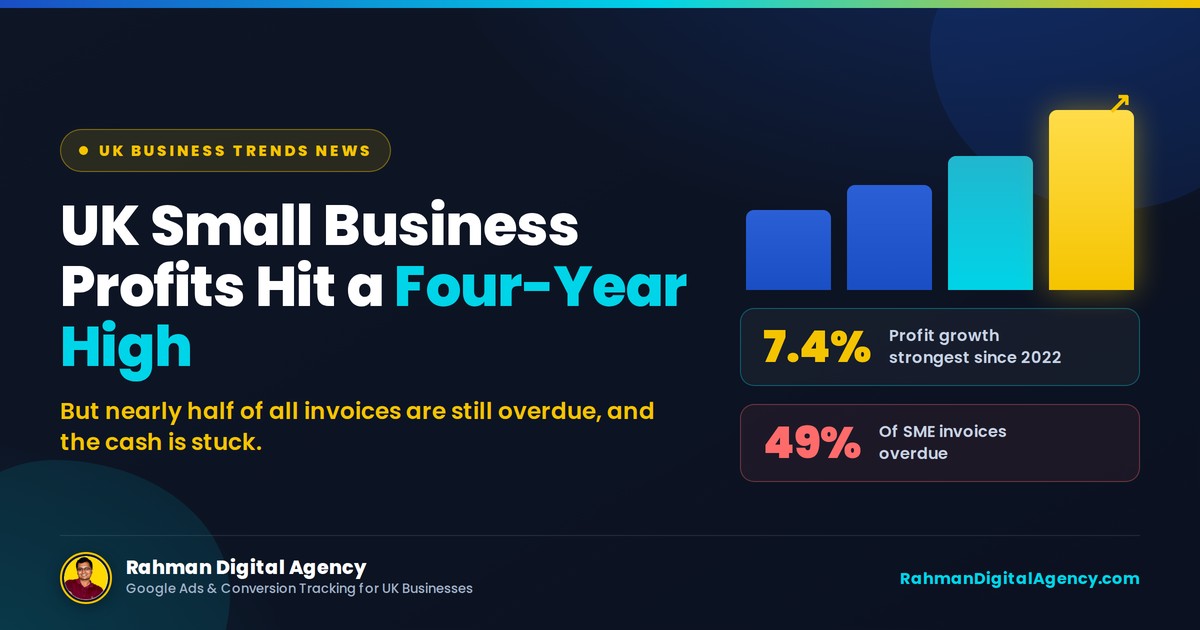
UK small business profit growth reached 7.4 per cent in the year to the first quarter of 2026, the strongest pace since 2022. The problem is that stronger profits are not turning into available cash, because nearly half of all invoices are still overdue.
The Headline Figure
UK small business profit growth reached 7.4 per cent in the year to the first quarter of 2026, according to the latest Sage SME Performance Pulse. That figure is up from 5.5 per cent the previous quarter, and it marks the strongest pace of growth since the first quarter of 2022.
The report draws on anonymised accounting data from nearly 150,000 UK small and medium businesses, so it reflects what firms are actually doing rather than survey sentiment. Alongside the profit figure, real revenues rose 3.2 per cent, a fourth consecutive quarter of growth. The wider economy moved in the same direction, with the Office for National Statistics recording quarter on quarter growth of 0.6 per cent, up from 0.2 per cent at the end of 2025.
Year to Q1 2026
Growth
Overdue
Late Payments
The Cash That Never Arrives on Time
Here is the part that matters for anyone running a business day to day. Profit on paper is not money in the bank. Sage found that around 49 per cent of SME invoices are overdue, with firms waiting an average of 27 days after issuing an invoice before payment arrives.
The delay is spreading through the supply chain. Small businesses are now taking an average of 37.1 days to pay their own suppliers, up from 31.9 days a year earlier. When one firm is paid late, it tends to pay the next firm late, and the pressure moves down the chain. Late payments are estimated to cost the UK economy around 11 billion pounds every year.
The human cost sits behind those numbers. Separate research from Bibby Financial Services found that 42 per cent of businesses have been unable to pay staff salaries on time because of delayed payments, and 24 per cent have paused hiring. The government estimates that 14,000 businesses close every year because they are not paid on time.
| Metric | Latest (Q1 2026) | Prior Reading |
|---|---|---|
| SME profit growth (year on year) | 7.4% | 5.5% (prev. quarter) |
| Real revenue growth | 3.2% | 4th quarter of growth |
| Invoices overdue | 49% | Persistent |
| Average wait to be paid | 27 days | After issuing invoice |
| Time SMEs take to pay suppliers | 37.1 days | 31.9 days (Q1 2025) |
| Small business spending growth | 1.6% | 4.8% (prior) |
| UK GDP (quarter on quarter) | 0.6% | 0.2% (Q4 2025) |
Where the Growth Is Strongest
The recovery is not evenly spread. The Midlands is doing the heavy lifting. The East Midlands leads the country on profitability, and Derby has now ranked first for two year revenue growth for a third consecutive quarter.
| Region | Profit Growth | Note |
|---|---|---|
| East Midlands | 20.2% | Leads UK |
| West Midlands | 16.3% | Second nationally |
| London | 10.6% | Third nationally |
| Derby (city, 2 yr revenue) | 43.6% | Top UK city |
Growth was also broad based across sectors rather than concentrated in one area, with manufacturing, professional services, technology and finance all contributing. For a small business owner, the read is simple. Demand is there, and the market is moving again. The question is who captures it.
The Warning Signs Underneath
One figure in the report should give owners pause. Small business spending growth fell sharply to 1.6 per cent, down from 4.8 per cent. Firms are earning more, but they are holding back on spending. That is the behaviour of a business owner who does not fully trust the momentum yet, and who is protecting cash while invoices sit unpaid.
This is the real signal. When profit is up but confidence is cautious and cash is tied up in overdue invoices, the winning move is not to chase every bit of extra volume. The winning move is to be more deliberate about which customers you take on, because the wrong customer, one who pays late or negotiates you down to a thin margin, costs you more than the revenue is worth.
What This Means for Your Business
We read reports like this through one lens: how does a business owner turn a market trend into a stable pipeline. Our view is that this quarter marks a shift in what a growing business actually needs.
For the past few years the message to most small businesses was to find more customers. This data changes the priority. When cash is trapped in overdue invoices and spending confidence is soft, the businesses that stay healthy are the ones that win the right customers, the ones who pay on time and buy at a sensible margin. That is a lead quality problem, not a lead volume problem.
This is where marketing meets cash flow, and where most advertising spend quietly goes wrong. More traffic, more clicks and more enquiries do not help you if the enquiries are low intent, slow to pay, or the wrong fit. In our experience across more than 50 UK accounts in construction, contracting, fit out and trade, the accounts that recovered fastest were not the ones with the biggest budgets. They were the ones tracking real leads, the calls, the form fills and the WhatsApp enquiries, rather than raw clicks, and feeding that data back so that Google Ads spent the budget on the customers worth having.
If you are running Google Ads and you are not sure whether your spend is bringing in customers who pay on time, the place to start is your tracking. Most accounts we audit are optimising toward a metric that does not reflect real revenue. Fix the measurement first, then the targeting, and the pipeline becomes something you can plan around rather than hope for.
[INTERNAL: Google Ads management service] and [INTERNAL: GA4 conversion tracking] are the two levers we use most often to move an account from click counting to real lead tracking. If you would like a straight answer on where your account is leaking, [INTERNAL: contact page] and we will take a look.
Key Takeaways
- UK SME profit growth reached 7.4 per cent in the year to Q1 2026, the strongest since 2022, up from 5.5 per cent.
- Real revenues rose 3.2 per cent, a fourth straight quarter of growth.
- Nearly half of all invoices (49 per cent) are overdue, with an average 27 day wait to be paid.
- Late payments cost the UK economy an estimated 11 billion pounds a year, and 14,000 firms close annually as a result.
- Spending growth slowed sharply to 1.6 per cent from 4.8 per cent, a clear sign of caution.
- The advantage now sits with businesses that win reliable, on time paying customers, not simply more volume.
- For advertisers, the priority shifts to lead quality and accurate conversion tracking over click counts.
Frequently Asked Questions
How much did UK small business profits grow in the latest quarter?
UK SME profits grew by 7.4 per cent in the year to the first quarter of 2026, according to the Sage SME Performance Pulse. That is up from 5.5 per cent the previous quarter and the strongest rate of growth since 2022.
What percentage of SME invoices are overdue in the UK?
Around 49 per cent of SME invoices are overdue. Businesses wait an average of 27 days after issuing an invoice before payment arrives, and SMEs themselves now take about 37.1 days to pay their own suppliers.
How much do late payments cost the UK economy?
Late payments are estimated to cost the UK economy around 11 billion pounds every year. The government estimates that 14,000 businesses close annually because they are not paid on time.
Which UK regions saw the strongest profit growth?
The East Midlands led profitability growth at 20.2 per cent, followed by the West Midlands at 16.3 per cent and London at 10.6 per cent. Derby ranked first among UK cities for two year revenue growth at 43.6 per cent.
What does this report mean for businesses running Google Ads?
With cash tight and confidence cautious, the priority shifts from lead volume to lead quality. The businesses that benefit are the ones targeting customers who pay on time and buy at a sensible margin, which means optimising Google Ads toward accurately tracked, real leads rather than raw clicks.
Growth Is Back. The Advantage Is in Who You Win.
The market is moving again, but this report is a reminder that more volume is not the same as a healthier business. The firms that come out of this quarter stronger will be the ones that win reliable customers and can see, campaign by campaign, which spend brings in real revenue.
If you want a clear read on whether your Google Ads budget is attracting customers who actually pay, send us a message. We will tell you what we see, in plain terms.
We track UK business trends through one question: how does a growing market turn into a pipeline you can plan around. Across 50+ accounts in construction, contracting and trade, we help owners measure real leads and put their Google Ads budget where the paying customers are. Available for UK and global clients.
- Sage SME Performance Pulse, published 15 June 2026. Anonymised accounting data from nearly 150,000 UK SMEs, aggregated by Smart Data Foundry and analysed by Cebr.
- Office for National Statistics (ONS): UK quarter on quarter GDP, Q1 2026.
- Bibby Financial Services: research on the impact of late payments on salaries and hiring.
- Small Business Commissioner: commentary on payment practices and the Late Payments Bill.
Figures are reported as published by the sources above. This article summarises third party data with editorial commentary from Rahman Digital Agency.