Small-business planning guide
A sensible digital marketing budget for small business growth does not begin with an arbitrary percentage or a competitor’s monthly spend. It begins with the customers you can serve, the gross profit available to acquire them, the rate at which qualified enquiries become customers, and the minimum investment each chosen channel needs to produce useful evidence.
Where should a small-business marketing budget start?
Start with business capacity, not a channel menu. A campaign that creates more demand than the team can answer wastes money and damages the customer experience. A campaign that generates low-margin work may look successful in an advertising dashboard while weakening the business.
Before choosing SEO, Google Ads, social media or a website project, answer these questions:
- Which service, product or customer segment should grow?
- How many additional customers can the business serve each month without reducing quality?
- What is the expected gross profit from a typical new customer over a sensible time period?
- What proportion of qualified enquiries becomes paying customers?
- How quickly does cash return after marketing spend?
- Which regions, service lines or order values should be excluded?
- Can the business answer calls and forms quickly, and who owns follow-up?
- Are the website, offer and measurement strong enough to support paid traffic?
These answers turn “How much should we spend?” into a decision about unit economics and operational capacity. They also expose when marketing is not the first problem to solve. If leads wait three days for a reply, a faster response process may improve performance before another advertising campaign is added.
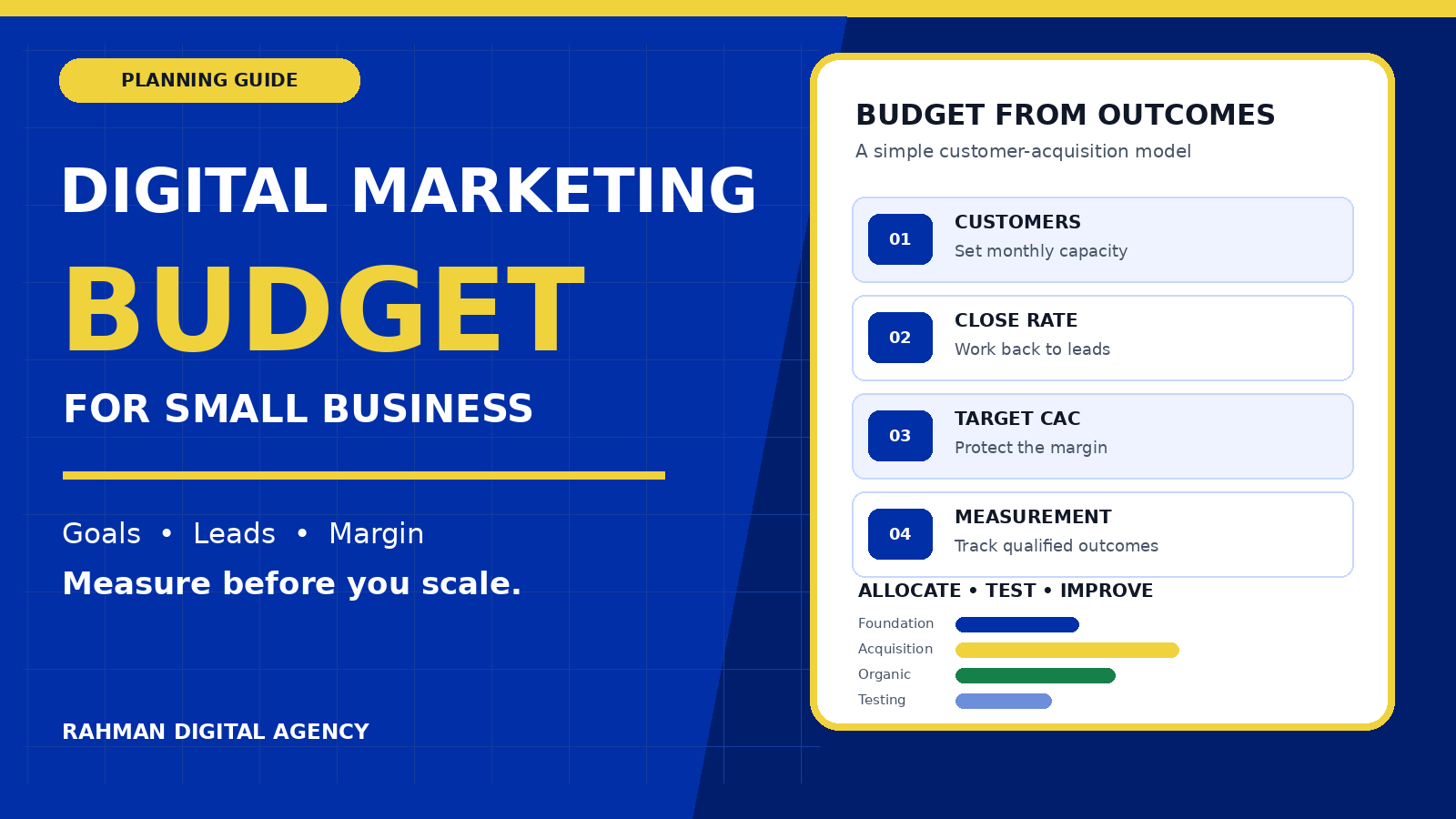
The four-number model for a defendable budget
You do not need a complex financial model to establish a useful starting range. Four numbers create a practical foundation.
Choose the number of additional customers you can fulfil in a month. Use capacity and cash flow rather than ambition alone.
Set the maximum total marketing and sales cost you are prepared to pay for one new customer while preserving acceptable margin.
Measure the percentage of genuinely qualified enquiries that become paying customers. Do not mix spam, job applications or unsupported locations into the denominator.
Estimate how many qualified opportunities a channel must create before you can judge whether the result is repeatable rather than a single lucky outcome.
Core planning formulas
Qualified leads required = new customers wanted ÷ close rate
Allowable cost per qualified lead = target acquisition cost × close rate
Acquisition budget ceiling = new customers wanted × target acquisition cost
The acquisition budget ceiling is not automatically the amount to spend. It is a commercial boundary. The actual test budget also depends on likely click costs, conversion rate, sales-cycle length, minimum creative and landing-page work, and whether the channel can generate enough volume in the chosen geography.
Use gross profit, not revenue, as the anchor
A high-revenue customer can still be expensive to deliver. Include direct fulfilment cost, discounts, payment fees, likely refunds, sales effort and ongoing support when estimating what a customer is worth. If the business has strong repeat purchasing, use a conservative contribution over a clearly defined period rather than an unlimited lifetime value.
Then decide what portion of that contribution can fund acquisition while leaving room for overhead, risk and profit. This is a management decision, not a universal industry percentage.
Worked example: calculate a starting acquisition budget
Consider a service business that wants four additional customers per month. It closes 20% of qualified enquiries and can responsibly invest up to 15,000 units of its local currency to acquire a new customer.
| Input or output | Calculation | Result |
|---|---|---|
| New customers wanted | Capacity decision | 4 per month |
| Qualified-lead close rate | Measured from CRM outcomes | 20% |
| Qualified leads required | 4 ÷ 0.20 | 20 |
| Target acquisition cost | Margin decision | 15,000 per customer |
| Allowable cost per qualified lead | 15,000 × 0.20 | 3,000 |
| Acquisition budget ceiling | 4 × 15,000 | 60,000 per month |
The 60,000 figure is not a media recommendation. It is the maximum total acquisition cost supported by these assumptions. If the business needs a landing page, tracking repair, call handling or creative production, those costs belong in the plan. If paid search is unlikely to produce 20 qualified enquiries within the boundary, the team must improve conversion, raise the customer value, extend the test, choose another channel or lower the growth target.
Run a second scenario at a weaker close rate. If the close rate falls from 20% to 10%, the allowable qualified-lead cost falls from 3,000 to 1,500. That sensitivity test shows why sales follow-up and lead quality are budget issues, not merely operational details.
What should a digital marketing budget include?
Many small businesses compare only advertising fees. A workable budget covers the entire route from discovery to measurement and follow-up.
1. Measurement and decision infrastructure
This includes analytics configuration, consent controls where required, call and form tracking, CRM fields, lead-source capture, reporting and quality checks. Google Analytics describes a key event as an action particularly important to the business; collected events can be marked as key events. Use that capability to distinguish meaningful actions from ordinary page views. See Google’s guidance on key events in Google Analytics and setting up web conversions for Google Ads.
2. Conversion assets
Budget for the pages, copy, offer, proof, forms, phone experience and creative required to turn attention into a qualified conversation. Sending traffic to an unclear page can make the channel appear expensive when the real defect is the destination.
A full redesign is not always necessary. Sometimes one focused service page, a stronger quotation form and faster mobile performance are enough for the first test. If a larger rebuild is justified, use a written scope and compare it with a realistic website cost plan.
3. Demand capture
Demand-capture channels reach people already looking for a solution. Search advertising and high-intent service pages are common examples. The budget must account for media, campaign management, search-term review, landing-page improvement and conversion validation.
4. Demand creation and trust
Some buyers are not searching yet, or they need evidence before enquiring. Useful articles, case studies, email, video, social proof and remarketing can build familiarity. This work normally compounds over time, so judge it with appropriate leading and commercial indicators rather than expecting every asset to create immediate sales.
5. Local discovery
Eligible businesses can add or claim a Google Business Profile at no charge. After verification, customers can find the business on Search and Maps and the owner can control key business information. The profile itself may be free, but accurate categories, services, photos, review handling, landing pages and tracking still require time and ownership. Read Google’s instructions to add or claim a Business Profile.
6. Management and improvement
Include the work required after launch: query review, exclusions, bids, creative testing, page improvements, reporting, stakeholder meetings and change control. A setup-only budget leaves no capacity to respond to what the data reveals.
Three practical budget-allocation patterns
There is no universal split. Use the pattern that matches the business’s current constraint, then translate each percentage into named deliverables and owners.
| Business situation | Foundation and measurement | Acquisition | Organic and trust assets | Testing and improvement |
|---|---|---|---|---|
| Prove the route Weak tracking, unclear page or new offer | 35–45% | 25–35% | 10–20% | 10–20% |
| Grow a proven service Good page, reliable tracking and known close rate | 10–20% | 45–60% | 15–25% | 10–20% |
| Reduce channel dependence Paid acquisition works but the business needs durable discovery | 10–15% | 30–45% | 30–40% | 10–15% |
These are planning ranges, not benchmarks. “Foundation” should decline only after the basics work. “Acquisition” should increase only when lead quality, fulfilment and measurement can support it. Organic work should have a defined service cluster and internal-link plan, not a volume target for generic articles.
Separate one-off and recurring costs
Create two lines in the budget:
- Build costs: tracking implementation, landing page, CRM configuration, photography, initial campaign structure and major technical repairs.
- Run costs: media, content production, optimisation, reporting, software, call handling and ongoing page improvements.
This prevents an expensive first month from being mistaken for the normal monthly requirement. It also prevents a low recurring fee from hiding the initial work needed to make the campaign measurable.
How to set a minimum viable budget by channel
Google Ads
Estimate likely clicks using the actual locations, services and search themes you intend to target. Then estimate how many clicks are needed to produce enough qualified conversions for a test. A tiny budget spread across many campaigns, locations and services may never give any one segment a fair chance.
Remember that Google Ads uses an average daily budget. Google explains that spend may be higher on some days through overdelivery while remaining subject to the applicable monthly spending limit. Review Google’s explanation of average daily budgets and overdelivery before translating a monthly boundary into campaign settings.
Include management and page work separately from media. Review search terms, location quality, device performance and conversion integrity. Our guide to finding Google Ads budget leaks shows why exclusions and measurement matter after launch. Businesses that need ongoing campaign ownership can also review our Google Ads management service.
SEO and service content
An SEO budget should support a real customer journey: technical access, indexable service pages, useful navigation, descriptive URLs, local signals where relevant, credible content and measurement. Google’s SEO Starter Guide recommends descriptive URLs that help users understand whether a result is useful. The same user-first principle should guide titles, headings and internal links.
Do not buy a fixed number of articles without a service map. Prioritise the pages that explain what the business does, who it helps, where it works, what the process involves and how a buyer can take the next step. Support those pages with distinct guides that answer genuine pre-sale questions.
Website and landing pages
Budget for the smallest page improvement that removes the current conversion barrier. That may be clearer positioning, service detail, trust evidence, mobile layout, response expectations or a shorter form. Test the complete path, including confirmation messages and CRM delivery.
Social and creative
Separate production from distribution. Decide whether the channel’s job is reach, remarketing, education, recruitment or direct response. A monthly posting package without a target audience, offer, distribution plan and measurement method is an activity budget, not a growth plan.
Email and retention
For businesses with permission to contact an existing audience, email can support repeat purchases, renewals, referrals and lead nurturing. Budget for list hygiene, segmentation, useful content, automation, consent and suppression handling. Do not treat a purchased list as a shortcut.
Build measurement before increasing spend
A useful dashboard connects marketing activity to qualified commercial outcomes. It should help an owner decide what to continue, change or stop.
Define the funnel in plain language
- Enquiry: a form, call, message or booking reaches the business.
- Qualified enquiry: it meets documented service, location, budget or fit criteria.
- Sales opportunity: the business confirms a real buying process or next step.
- Customer: the agreed commercial event occurs, such as a signed contract or paid order.
- Gross profit: revenue is adjusted for direct delivery cost.
Record why leads are disqualified. A campaign producing many enquiries from the wrong location needs a different fix from a campaign producing valid enquiries that sales staff fail to contact.
Use a small scorecard
| Metric | What it answers | Common caution |
|---|---|---|
| Spend by channel | Where did the budget go? | Include management and asset costs, not media alone. |
| Qualified leads | Did the channel reach plausible buyers? | Use one written qualification definition. |
| Cost per qualified lead | How efficiently did the channel create sales-ready conversations? | Small samples can move sharply. |
| Close rate | How well did qualified opportunities become customers? | Segment by service and lead source. |
| Customer acquisition cost | What did each new customer cost? | Include sales and marketing cost consistently. |
| Gross profit after acquisition | Did the acquired work contribute economically? | Revenue alone can hide delivery cost. |
| Response time | How quickly did the team act? | Measure during business hours and define ownership. |
If tracking is incomplete, fix it before making a large scale decision. Our guide to GA4 and GTM conversion tracking explains the implementation layers that support reliable measurement.
A practical 90-day budget plan
Days 1–30: establish the baseline and repair the route
- Choose one service, customer segment and location.
- Calculate target acquisition cost and allowable qualified-lead cost.
- Audit the page, offer, mobile path, forms, phone handling and response time.
- Define qualification and sales stages.
- Implement or validate analytics, advertising conversions and CRM capture.
- Record the current lead, close-rate and gross-profit baseline.
Days 31–60: run one controlled acquisition test
- Launch a narrow campaign or service-page programme with clear exclusions.
- Keep a change log so the team knows what altered performance.
- Review search terms, lead quality, page behaviour and delivery failures.
- Protect enough budget to gather a useful sample; do not reset the campaign every few days.
- Improve follow-up scripts and route qualified opportunities to a named owner.
Days 61–90: compare commercial outcomes
- Reconcile platform conversions with qualified leads and customers.
- Calculate cost per qualified lead and customer acquisition cost.
- Separate channel defects from sales, capacity and fulfilment constraints.
- Scale only the segments that meet the commercial boundary and service-quality standard.
- Document what will continue, what will change and what will stop.
Continue when the campaign produces the right type of enquiry, the team follows up reliably, conversion records reconcile with the CRM and the acquisition cost fits the agreed margin. Improve the page or sales route when traffic is relevant but qualified conversion is weak. Pause when the offer cannot be fulfilled profitably, lead quality remains outside scope, or measurement cannot support the spending decision.
Signs the marketing budget is too small, too large or badly structured
It may be too small when:
- The budget is divided across so many services and locations that none receives meaningful exposure.
- Media is funded but conversion tracking, landing pages and follow-up are excluded.
- The test ends before the normal sales cycle can produce outcomes.
- One or two leads are expected to prove a stable acquisition cost.
- The plan depends on unpaid staff time that no one has reserved.
It may be too large when:
- The business cannot answer or fulfil the additional demand.
- The budget rises faster than qualified-lead volume or gross profit.
- Campaigns expand into weaker services or locations merely to spend the allocation.
- Tracking discrepancies are known but scale continues anyway.
- Customer acquisition cost exceeds the commercial boundary and no corrective hypothesis is being tested.
It may be badly structured when:
- Every channel receives money because it appears on a standard package.
- Reporting rewards impressions and clicks while ignoring qualification and sales outcomes.
- One-off build work and recurring management are mixed together.
- SEO content is disconnected from live service pages.
- The agency owns essential accounts, data or creative with no clear handover route.
What to include when briefing a digital marketing agency
A clear brief makes proposals comparable and helps an agency challenge unrealistic assumptions. Include:
- The service, location and customer segment to prioritise
- Monthly capacity and any seasonality
- Typical order value, repeat pattern and gross-margin range
- Current enquiry volume, qualification rate and close rate
- Target acquisition-cost boundary
- Known website, tracking, CRM or response-time problems
- Existing accounts and who owns them
- One-off budget, recurring budget and decision horizon
- Required deliverables, reporting fields and meeting cadence
- Approval, access, data and handover expectations
Ask the supplier to distinguish media spend, setup, management, content, creative, software and tax. Ask which assumptions must be true for the proposal to work and how lead quality will be verified. Our digital marketing agency selection checklist provides a broader framework for comparing strategy, measurement, ownership, scope and reporting.
Frequently asked questions
What percentage of revenue should a small business spend on digital marketing?
A percentage can be a high-level affordability check, but it should not replace unit economics. Two businesses with the same revenue can have very different margins, repeat rates, capacity, sales cycles and growth goals. Work from gross profit, target acquisition cost, close rate and the minimum viable channel test, then compare the result with cash flow.
Should a small business choose SEO or Google Ads first?
Choose based on timing, demand, competition, website readiness and measurement. Google Ads can test high-intent demand quickly but requires media and active management. SEO can build durable discovery but usually needs technical, service-page and content work over a longer horizon. Many businesses use paid search to test messages while building a focused organic service cluster.
How long should a marketing budget be tested?
The test window should cover enough qualified opportunities and the normal sales cycle. A high-volume local service may learn faster than a complex B2B service with a multi-month decision process. Set the period, sample target and decision rules before launch rather than stopping after a single weak week or extending indefinitely.
Should agency fees be included in customer acquisition cost?
Yes, if the goal is to understand the full cost of acquiring customers. Use a consistent definition that includes relevant media, agency or staff time, creative, software and conversion assets. For management decisions, separate one-off build costs from recurring acquisition costs as well as reporting the combined view.
What if the business has no reliable close-rate data?
Start with a short measurement period. Define a qualified enquiry, record every outcome, and use a cautious range for planning. The first budget may prioritise tracking, CRM discipline and a narrow test rather than immediate scale.
Can a very small budget still work?
It can work when the scope is narrow. Choose one service, one audience, one location and one measurable route. Use free foundations where suitable, such as a verified Google Business Profile, and invest in the page, follow-up and measurement needed to convert attention. Avoid dividing a limited budget across many unrelated campaigns.
Useful official resources
Build a budget around qualified customers, not channel activity
Rahman Digital Agency can help define the commercial model, repair measurement, prioritise the customer journey and manage a focused acquisition plan. Review our digital marketing services or discuss the service you want to grow.
Request a digital marketing planning call