
Posted on

Your Professional Network Is a Business Asset: Is a Local Marketing Agency Right for You?

Rahman Digital Agency graphic: Your network is a business asset. Is a local marketing agency right for you? Photo of founder Mahmudur Rahman.

You’ve worked with local business owners for years. Maybe you bought from them as a procurement manager. Maybe you sold to them, consulted for them, or helped them get through a difficult quarter. They take your calls. They tell you what’s going wrong.

You may also have noticed that many of them struggle with the same things. Their website is out of date, nobody keeps their Google Business Profile current, and they can’t tell whether their advertising is working.

That raises a reasonable question: could the relationships you already have be the start of a business?

For some people, the answer is a local digital marketing agency. For others, it’s a distraction they’d regret. This guide explains how the model works and what a professional network can and can’t do for you. It ends with a practical way to test your fit before you spend money.

What a local marketing agency actually is

At its simplest, a local marketing agency helps businesses in a defined area or industry get found and contacted by customers. The common services are:

  • Websites and landing pages that load quickly, work on phones, and make it easy to call or send an inquiry.
  • Local search visibility, including Google Business Profile management, reviews, and on-page SEO.
  • Paid advertising, such as Google Ads, managed with clear goals and budgets.
  • Tracking and reporting, so the business can see which activity produces calls, forms, and bookings.

Every agency has two separate jobs, and it helps to see them clearly from the start.

  1. Client leadership. This means choosing a market, understanding a business’s problem, recommending a sensible solution, agreeing on scope and price, managing expectations, and staying accountable for the relationship.
  2. Technical delivery. This means building the website, configuring the tracking, running the campaigns, and completing the agreed work to an acceptable standard.

Some founders do both. Others focus on client leadership and use employees, freelancers, or a white-label fulfillment partner for the technical delivery. In a white-label arrangement, the partner does agreed work behind the agency’s brand while the agency stays the client’s point of contact.

What doesn’t change in either model: the client hired your agency. You’re responsible for what you sell, what you promise, and how the relationship is handled.

Why relationships matter at the very beginning

When you start an agency, you’re unknown. You have no portfolio, no reviews, and no case studies. Cold outreach to strangers is hard in that position, because nobody has a reason to trust you yet.

Founders who share their experiences online often say their first clients came from people they already knew: former colleagues, friends with businesses, and warm introductions. In one Reddit discussion about how agency owners got their first client, several replies describe exactly that pattern (r/AskMarketing). Another thread for beginners makes the same point bluntly: early clients tend to come through your own network (r/DigitalMarketing). These are anecdotes, not research, but the pattern comes up often enough to take seriously.

So if you already have trusted access to business owners, you may have the part that many new agencies find hardest to build. They’ll take your call and tell you honestly what isn’t working.

What a network does not do

It’s easy to overestimate a network, so be clear about its limits.

  • A network is not a pipeline. Knowing someone doesn’t mean they need marketing help, have budget for it, or want to buy it from you.
  • Goodwill is not a sales process. You still need a clear offer, a sensible price, a written scope, and the willingness to ask for the business. Some conversations will go nowhere.
  • Relationships can be damaged. If you oversell or underdeliver to someone you know, you can lose more than a client. You can lose a friendship or a professional reputation that took years to build.
  • Some relationships are not yours to use. Contacts you manage on behalf of an employer may be covered by your employment agreement, a conflict-of-interest policy, or non-solicitation terms. Check before you approach anyone, and get professional advice if you’re unsure.

None of this rules the model out. It means you should treat your network as a starting advantage to use carefully, not as guaranteed revenue.

Signs this model might fit you

You don’t need a marketing background. In our view, the people who tend to do well share a few traits.

  1. You have real, two-way relationships with business owners or decision-makers, not just a large contact list.
  2. You’re comfortable with sales conversations. You can ask questions, listen, make a recommendation, and talk about price without discomfort.
  3. You’re organized and follow through. You can run a process, keep commitments, and stay on top of deadlines and approvals.
  4. You can invest time and money before revenue arrives. Setting up a business, a brand, and an agency website takes both.
  5. You’re willing to learn the fundamentals of the services you sell, even if someone else delivers them.

Signs it probably doesn’t fit you

Be just as honest about these.

  • You want passive income. Even with technical delivery outsourced, an agency involves selling, client communication, approvals, and problem-solving every week.
  • You expect a partner to manage your clients for you. A delivery partner works to a brief. Owning the relationship, and the hard conversations, stays with you.
  • You can’t spare regular time during business hours. Clients call during the day, and sold work has deadlines.
  • You’re relying on one or two contacts. If the whole plan depends on a single person saying yes, the business is fragile from day one.
  • You’d be uncomfortable telling a client “no” or “that’s not guaranteed.” Honest agencies don’t promise rankings, leads, or revenue. Many of your conversations will involve setting realistic expectations.

Skills that transfer from your current career

Many professional roles build skills that matter more in a small agency than technical know-how does.

  • Procurement and operations build skill in scoping, comparing suppliers, managing timelines, and holding vendors to agreed standards. That is close to how an agency manages a delivery partner.
  • Sales and business development build skill in discovery questions, handling objections, proposals, and follow-up.
  • Consulting builds skill in diagnosing a problem, framing options, and explaining trade-offs in plain language.
  • Account and client management build skill in setting expectations, communicating, and keeping relationships healthy.

What tends to be missing is knowledge of the services themselves. You don’t need to build websites or run ad accounts, but you do need to understand them well enough to explain them, review work, spot problems, and set honest expectations. Experienced agency owners in online discussions consistently stress this point (r/agency).

A 30-minute network audit

Before you spend anything on a brand or a website, test your assumption with a simple exercise. Use a spreadsheet or a notebook. Keep it private, and don’t share anyone’s details with third parties.

  1. List about 30 business owners or managers you know by name. Skip anyone you’ve only connected with online.
  2. Note each person’s industry and general area. Look for clusters, such as several contractors, several clinics, or several restaurants.
  3. Mark who makes or influences marketing decisions. An owner of a small business usually does. A manager at a large chain usually doesn’t.
  4. Mark who has mentioned a relevant problem in the past year: a website they’re unhappy with, few reviews, unpredictable leads, or ads they don’t trust.
  5. Mark who would take a 20-minute call from you this month. Be honest.
  6. Flag anyone connected to your current employer. Leave them out until you’ve checked your obligations.

If very few names make it through, that’s useful information. Your first step may be building relationships, not launching a business. If a meaningful group makes it through, and especially if they cluster in one or two industries, you’ve found the start of a market you understand.

Questions to answer before you spend money

Work through these questions on paper first.

  • Who exactly would you serve? For example, which city or region, and which one to three industries?
  • What one or two services would you sell first? Pick services that match the problems your contacts actually mention, not the longest possible menu.
  • Who would deliver the work? You, a hire, freelancers, or a white-label partner, and how would you check quality?
  • How many hours a week can you commit, and when? If you’re employed, be realistic about daytime calls.
  • What can you invest before the first client pays? Think in categories: setup, tools, your agency website, legal and accounting advice, and working capital.
  • What would you tell a client if results were slower than they hoped? If you don’t have an honest answer yet, that’s part of the work.

A practical next step

If the audit and these questions leave you cautiously interested, take your time with the next stage. Learn the basics of the services you’d sell. You could start by understanding how leads are measured, for example how contact form conversion tracking works on WordPress and what Google Tag Manager does. Talk to a professional about registering a business where you live. The U.S. Small Business Administration has a plain-English guide to registering a business.

If you already run an agency and want to understand how a delivery partnership can be structured, read RDA’s overview of white-label digital marketing fulfillment. If you have questions about your situation, you can reach the team through the contact page.

Starting an agency is real work, and no one can promise you clients or income. But if you’ve spent years earning the trust of local business owners, the model is worth understanding properly before you decide either way.

Sources and further reading

This article is general information, not legal, tax, or financial advice. Speak to a qualified professional where you live.
Posted on

Work Dried Up? A 30-Day Lead Generation Plan for Tradespeople

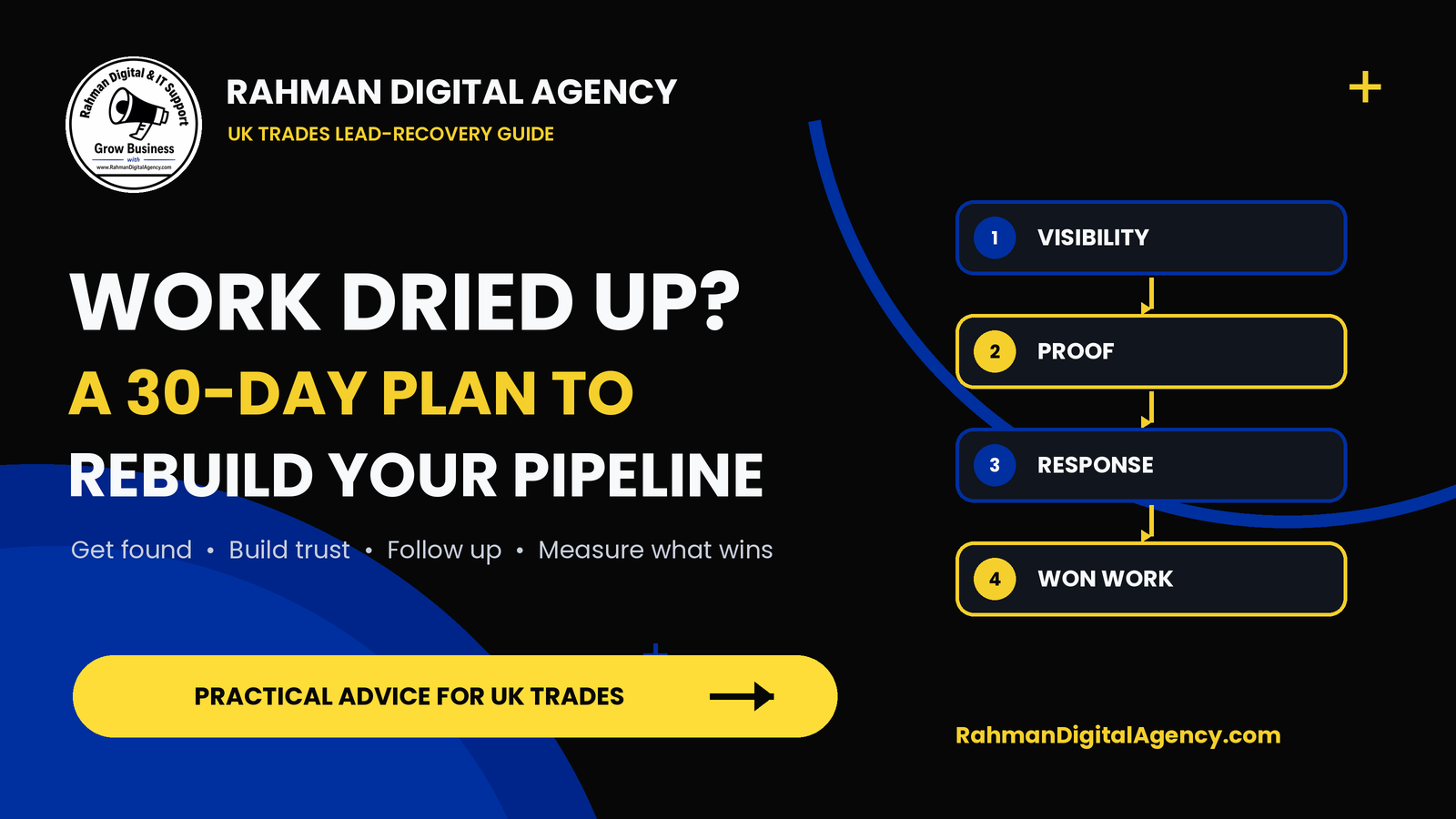
Thirty-day lead generation plan for UK tradespeople covering visibility, proof, response and won work

UK trades lead-recovery guide

If you have been busy for years but the phone has suddenly gone quiet, do not assume your skills are the problem. First find where your enquiry pipeline broke—visibility, trust, response, quotation or follow-up—then repair it in a measured order.

The short version: track the last 90 days, reactivate genuine relationships, improve local visibility, publish project proof, tighten your quote process and test one acquisition channel at a time. The plan below applies to many UK trades and includes practical kitchen- and bathroom-fitting examples.

A quiet diary is frightening when your business has previously relied on recommendations and steady repeat work. The natural reaction is to cut prices, buy a list of leads or launch ads immediately. Those actions can create more pressure if you do not know which part of the pipeline is failing.

One tradesperson can be short of work while a homeowner in the same region is struggling to find someone suitable. That is a demand-matching problem: the customer may not see the business, may not understand its speciality, may not trust the available proof, or may not receive a useful response quickly enough. Effective lead generation for tradesmen therefore begins with diagnosis—not a promise that one platform will solve everything.

First, identify where the work actually dried up

Review the previous 90 days and compare them with a healthy period. Use a notebook or spreadsheet; sophisticated software is optional. Record each genuine enquiry, its source, service, postcode, approximate value, response time, whether you quoted, whether you followed up and whether it became a job.

SignalWhat it may indicateFirst response
Very few enquiriesVisibility, referral activity or demand-source problemCheck Google visibility, past-customer referrals, local partnerships and service-area clarity
Enquiries arrive but are unsuitableMessage or targeting is too broadState your speciality, locations, minimum project fit and what is not included
Site visits happen but few quotes are acceptedTrust, scope, price explanation or follow-up problemImprove proof, itemise scope, explain assumptions and schedule follow-up
Quotes are accepted but margin is poorPricing, variation control or qualification problemQualify earlier, document exclusions and stop using discounting as the main sales tool
Do not confuse activity with progress. Ten low-quality directory enquiries can consume more time than two well-matched homeowner enquiries. Track qualified opportunities and won work, not only messages or clicks.

The five foundations of a healthier trades pipeline

1. Clear positioning

“General building work” is difficult to evaluate. “Full kitchen installation across Leeds, including rip-out, fitting and trade coordination” helps a homeowner decide whether you fit the project.

2. Local discovery

Your website, Google Business Profile and relevant directories should agree on what you do, where you work and how a customer can contact you.

3. Visible proof

Show completed projects with location context, starting problem, scope, photographs, timescale and a genuine customer review where permission exists.

4. Fast, useful response

A reply should move the job forward: confirm the service area, ask qualifying questions and set an exact next step rather than sending “How can I help?”

5. Consistent follow-up

Many quotes are neither accepted nor rejected immediately. A polite, scheduled follow-up gives the customer a chance to ask questions without creating pressure.

6. Measured acquisition

Directories, organic search, referrals and advertising can all contribute. Keep source and outcome records so you know which channel produces profitable jobs.

Google explains that complete and accurate business information can help local visibility, while local results are mainly based on relevance, distance and prominence. Reviews, links and the information associated with the business can contribute to prominence. Read Google’s guidance on improving local ranking before paying anyone who claims they can buy a guaranteed local position.

A practical 30-day lead recovery plan

Days 1–3: build the pipeline baseline

List every enquiry from the last 90 days. Calculate enquiry-to-visit, visit-to-quote and quote-to-win rates. Note average response time and the source of each won job. If the records are incomplete, begin tracking from today rather than inventing numbers.

Days 4–7: reactivate trust you have already earned

Contact suitable past customers individually where it is appropriate and lawful. Ask whether the completed work is still performing well, invite an honest review and make it easy to recommend you to someone who needs the same service. Do not upload old customer details into bulk marketing tools without checking consent and the rules that apply. The ICO’s electronic-mail marketing guidance explains the UK requirements.

Week 2: repair local visibility

Check your business name, phone, service areas, opening information, primary category, services, photographs and website link. Add recent project photographs regularly, but avoid stock images presented as your work. Create or improve a dedicated website page for each genuinely distinct high-value service instead of copying the same page for many towns.

Google allows businesses to request reviews with a link or QR code but prohibits incentives such as discounts in exchange for reviews. Follow its review guidance and respond professionally to positive and negative feedback.

Week 3: turn completed work into decision-making proof

Publish three useful project stories. Each should state the type of property, location area, customer problem, agreed scope, complications discovered, how they were handled, approximate timescale and final result. Remove personal details and obtain permission for identifiable photographs or quotations.

Week 4: test one controlled acquisition channel

Choose one channel that matches the service and location: a supplier partnership, a carefully selected lead platform, local organic search or a tightly targeted advertising test. Define the budget, qualification criteria, landing page, response owner and success measure before starting. Record qualified leads and won revenue, not only clicks.

Use customer behaviour as your checklist. Citizens Advice recommends that homeowners get written quotations, check references, agree payment arrangements and understand subcontracting and permissions before work starts. Make these decisions easier by showing clear scope, proof and terms before the customer has to chase you. See Citizens Advice guidance before home improvement work.

Example: a kitchen or bathroom specialist

Turn a broad service into a qualified enquiry path

A kitchen and bathroom business should not send every visitor to a generic homepage. Build separate, substantial service pages when the projects and customer decisions differ. A kitchen-installation page might explain rip-out, cabinetry fitting, worktop coordination, plumbing/electrical coordination, finishing, typical timescale factors and service areas. A bathroom page should address waterproofing, ventilation, tiling, sanitaryware, access and the boundary between supply-only, fit-only and full installation.

Use a short enquiry form that asks for postcode, room type, desired start period, whether materials are chosen, approximate budget band and permission to upload photographs. These questions reduce wasted calls while giving serious homeowners a clearer first step.

What to publish as proof

  • Before-and-after photographs from the same viewing angle.
  • A short explanation of the original problem and agreed result.
  • The main scope, including what your team did and what another trade supplied.
  • Location at town or district level without exposing a customer’s address.
  • Timescale factors and any variation handled during the work.
  • An authentic review linked to the relevant type of project.

When the website is built around these decisions, it becomes more than an online brochure. RDA’s guide to a lead generation website for a service business explains how service pages, proof, qualification and measurement should work together.

When should a trades business use paid advertising?

Advertising can accelerate an offer that already has a clear service, convincing proof, a suitable landing page and disciplined response. It cannot repair unclear positioning or poor follow-up. Before spending, confirm the locations you can profitably serve, the job types you want, what counts as a qualified lead and how calls and forms will be recorded.

Kitchen and bathroom businesses should separate high-intent installation searches from research, jobs, training, DIY and product-only searches. Send traffic to the matching service page—not automatically to the homepage. RDA’s detailed guide to PPC for bathroom designers covers campaign structure, lead quality and project-focused landing pages.

Budget only after the basic journey is sound. Our small-business digital marketing budget guide shows how to separate foundations, acquisition and measurement instead of spending everything on traffic.

Measure whether the plan creates real work

Review the numbers weekly. Track enquiries by source, qualified leads, appointments or site visits, quotes, wins, expected revenue, actual revenue and gross margin. On the website, a form button click is not the same as a completed enquiry. Google Analytics recommends the generate_lead event when a lead is actually generated; the event should fire only after the business has confirmed a successful submission. See Google’s recommended-event reference.

MetricWhy it mattersWeekly question
Qualified enquiriesShows whether visibility reaches suitable customersDid the person, job and location fit?
Median response timeSlow contact can lose an otherwise good opportunityHow quickly did we provide a useful next step?
Quote rate and win rateSeparates enquiry quality from the sales processWhere are suitable projects dropping out?
Cost per qualified leadPrevents cheap but irrelevant leads from looking successfulWhat did each real opportunity cost?
Won margin by sourceConnects marketing with sustainable workWhich source produced profitable jobs?

Frequently asked questions

What is the fastest way for a tradesperson to get more leads?

The fastest responsible starting point is usually to contact genuine past relationships appropriately, request honest reviews, improve quote follow-up and make current availability clear to local partners. These actions can work sooner than waiting for search visibility, but they still require permission, professionalism and accurate service information.

Should I use a trades lead platform?

It can be useful if the job types, geography, fees, competition and refund rules fit your business. Test with a fixed limit. Record every lead, whether it was contactable and suitable, and the margin from won jobs. Do not judge the platform only by the number of notifications.

Do I need a separate website page for every town?

No. Create location pages only where you genuinely serve the area and can provide distinct, useful information. Repeating the same page with a different town name does not help a homeowner make a decision. Strong service pages, project examples and accurate service-area information are a better foundation.

Should I lower my prices when work is quiet?

Not automatically. First check whether enough suitable people are finding you, whether your quote explains scope and value, and whether follow-up happens. Discounting cannot solve invisibility and may create margin problems. If you change pricing or packaging, document the reason and measure the result.

How long does local marketing take?

Past-customer referrals and better follow-up can create opportunities quickly. Website and local-search improvements usually need consistent work and do not guarantee a fixed timetable. Paid campaigns can generate traffic sooner, but only become useful when targeting, qualification, response and tracking are ready.

Useful references

Need a measurable lead-recovery plan?

Rahman Digital Agency can review your local visibility, service pages, project proof, enquiry journey, follow-up and advertising readiness—then prioritise the changes most likely to produce qualified opportunities.