
Posted on

Digital Marketing Budget for Small Business: A Practical Planning Guide

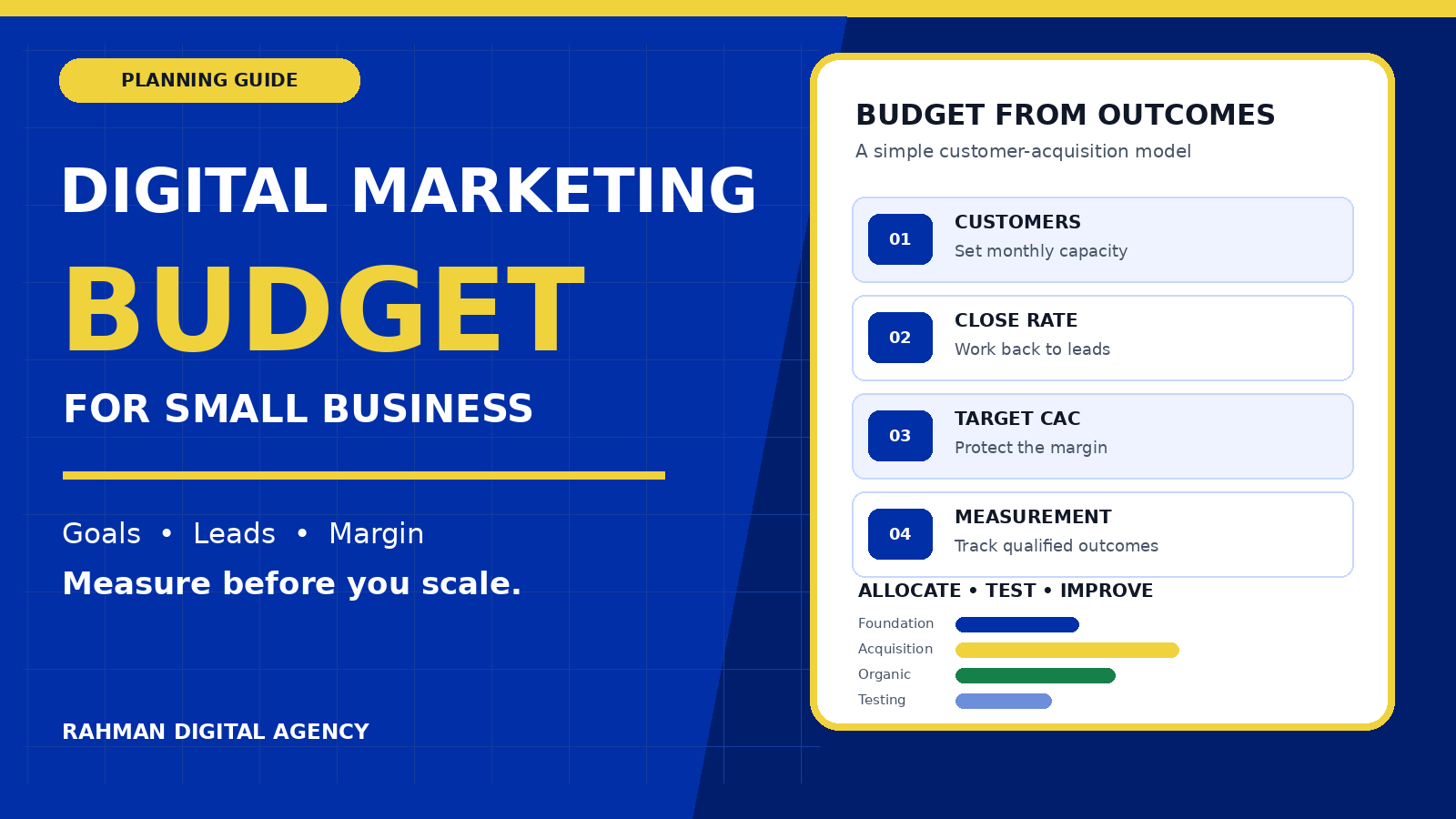
Digital marketing budget planning guide for small business showing customers, close rate, target acquisition cost and measurement in RDA blue and gold

Small-business planning guide

A sensible digital marketing budget for small business growth does not begin with an arbitrary percentage or a competitor’s monthly spend. It begins with the customers you can serve, the gross profit available to acquire them, the rate at which qualified enquiries become customers, and the minimum investment each chosen channel needs to produce useful evidence.

The practical answer: set a target customer-acquisition cost, work backwards through your close rate to an allowable cost per qualified lead, fund one coherent customer journey, and review results over a defined test window. Separate one-off foundations—tracking, landing pages and creative—from recurring media, content and optimisation. A smaller focused plan is usually more measurable than spreading the same money across every channel.

Where should a small-business marketing budget start?

Start with business capacity, not a channel menu. A campaign that creates more demand than the team can answer wastes money and damages the customer experience. A campaign that generates low-margin work may look successful in an advertising dashboard while weakening the business.

Before choosing SEO, Google Ads, social media or a website project, answer these questions:

  • Which service, product or customer segment should grow?
  • How many additional customers can the business serve each month without reducing quality?
  • What is the expected gross profit from a typical new customer over a sensible time period?
  • What proportion of qualified enquiries becomes paying customers?
  • How quickly does cash return after marketing spend?
  • Which regions, service lines or order values should be excluded?
  • Can the business answer calls and forms quickly, and who owns follow-up?
  • Are the website, offer and measurement strong enough to support paid traffic?

These answers turn “How much should we spend?” into a decision about unit economics and operational capacity. They also expose when marketing is not the first problem to solve. If leads wait three days for a reply, a faster response process may improve performance before another advertising campaign is added.

The four-number model for a defendable budget

You do not need a complex financial model to establish a useful starting range. Four numbers create a practical foundation.

1. New-customer target

Choose the number of additional customers you can fulfil in a month. Use capacity and cash flow rather than ambition alone.

2. Target acquisition cost

Set the maximum total marketing and sales cost you are prepared to pay for one new customer while preserving acceptable margin.

3. Qualified-lead close rate

Measure the percentage of genuinely qualified enquiries that become paying customers. Do not mix spam, job applications or unsupported locations into the denominator.

4. Required test volume

Estimate how many qualified opportunities a channel must create before you can judge whether the result is repeatable rather than a single lucky outcome.

Core planning formulas

Qualified leads required = new customers wanted ÷ close rate

Allowable cost per qualified lead = target acquisition cost × close rate

Acquisition budget ceiling = new customers wanted × target acquisition cost

The acquisition budget ceiling is not automatically the amount to spend. It is a commercial boundary. The actual test budget also depends on likely click costs, conversion rate, sales-cycle length, minimum creative and landing-page work, and whether the channel can generate enough volume in the chosen geography.

Use gross profit, not revenue, as the anchor

A high-revenue customer can still be expensive to deliver. Include direct fulfilment cost, discounts, payment fees, likely refunds, sales effort and ongoing support when estimating what a customer is worth. If the business has strong repeat purchasing, use a conservative contribution over a clearly defined period rather than an unlimited lifetime value.

Then decide what portion of that contribution can fund acquisition while leaving room for overhead, risk and profit. This is a management decision, not a universal industry percentage.

Worked example: calculate a starting acquisition budget

Consider a service business that wants four additional customers per month. It closes 20% of qualified enquiries and can responsibly invest up to 15,000 units of its local currency to acquire a new customer.

Input or outputCalculationResult
New customers wantedCapacity decision4 per month
Qualified-lead close rateMeasured from CRM outcomes20%
Qualified leads required4 ÷ 0.2020
Target acquisition costMargin decision15,000 per customer
Allowable cost per qualified lead15,000 × 0.203,000
Acquisition budget ceiling4 × 15,00060,000 per month

The 60,000 figure is not a media recommendation. It is the maximum total acquisition cost supported by these assumptions. If the business needs a landing page, tracking repair, call handling or creative production, those costs belong in the plan. If paid search is unlikely to produce 20 qualified enquiries within the boundary, the team must improve conversion, raise the customer value, extend the test, choose another channel or lower the growth target.

Run a second scenario at a weaker close rate. If the close rate falls from 20% to 10%, the allowable qualified-lead cost falls from 3,000 to 1,500. That sensitivity test shows why sales follow-up and lead quality are budget issues, not merely operational details.

Do not plan from cost per form submission alone. A cheap enquiry that never fits the service area, minimum order or buying criteria is not an efficient lead. Define qualification before the campaign starts and connect marketing records to sales outcomes.

What should a digital marketing budget include?

Many small businesses compare only advertising fees. A workable budget covers the entire route from discovery to measurement and follow-up.

1. Measurement and decision infrastructure

This includes analytics configuration, consent controls where required, call and form tracking, CRM fields, lead-source capture, reporting and quality checks. Google Analytics describes a key event as an action particularly important to the business; collected events can be marked as key events. Use that capability to distinguish meaningful actions from ordinary page views. See Google’s guidance on key events in Google Analytics and setting up web conversions for Google Ads.

2. Conversion assets

Budget for the pages, copy, offer, proof, forms, phone experience and creative required to turn attention into a qualified conversation. Sending traffic to an unclear page can make the channel appear expensive when the real defect is the destination.

A full redesign is not always necessary. Sometimes one focused service page, a stronger quotation form and faster mobile performance are enough for the first test. If a larger rebuild is justified, use a written scope and compare it with a realistic website cost plan.

3. Demand capture

Demand-capture channels reach people already looking for a solution. Search advertising and high-intent service pages are common examples. The budget must account for media, campaign management, search-term review, landing-page improvement and conversion validation.

4. Demand creation and trust

Some buyers are not searching yet, or they need evidence before enquiring. Useful articles, case studies, email, video, social proof and remarketing can build familiarity. This work normally compounds over time, so judge it with appropriate leading and commercial indicators rather than expecting every asset to create immediate sales.

5. Local discovery

Eligible businesses can add or claim a Google Business Profile at no charge. After verification, customers can find the business on Search and Maps and the owner can control key business information. The profile itself may be free, but accurate categories, services, photos, review handling, landing pages and tracking still require time and ownership. Read Google’s instructions to add or claim a Business Profile.

6. Management and improvement

Include the work required after launch: query review, exclusions, bids, creative testing, page improvements, reporting, stakeholder meetings and change control. A setup-only budget leaves no capacity to respond to what the data reveals.

Three practical budget-allocation patterns

There is no universal split. Use the pattern that matches the business’s current constraint, then translate each percentage into named deliverables and owners.

Business situationFoundation and measurementAcquisitionOrganic and trust assetsTesting and improvement
Prove the route
Weak tracking, unclear page or new offer
35–45%25–35%10–20%10–20%
Grow a proven service
Good page, reliable tracking and known close rate
10–20%45–60%15–25%10–20%
Reduce channel dependence
Paid acquisition works but the business needs durable discovery
10–15%30–45%30–40%10–15%

These are planning ranges, not benchmarks. “Foundation” should decline only after the basics work. “Acquisition” should increase only when lead quality, fulfilment and measurement can support it. Organic work should have a defined service cluster and internal-link plan, not a volume target for generic articles.

Separate one-off and recurring costs

Create two lines in the budget:

  • Build costs: tracking implementation, landing page, CRM configuration, photography, initial campaign structure and major technical repairs.
  • Run costs: media, content production, optimisation, reporting, software, call handling and ongoing page improvements.

This prevents an expensive first month from being mistaken for the normal monthly requirement. It also prevents a low recurring fee from hiding the initial work needed to make the campaign measurable.

How to set a minimum viable budget by channel

Google Ads

Estimate likely clicks using the actual locations, services and search themes you intend to target. Then estimate how many clicks are needed to produce enough qualified conversions for a test. A tiny budget spread across many campaigns, locations and services may never give any one segment a fair chance.

Remember that Google Ads uses an average daily budget. Google explains that spend may be higher on some days through overdelivery while remaining subject to the applicable monthly spending limit. Review Google’s explanation of average daily budgets and overdelivery before translating a monthly boundary into campaign settings.

Include management and page work separately from media. Review search terms, location quality, device performance and conversion integrity. Our guide to finding Google Ads budget leaks shows why exclusions and measurement matter after launch. Businesses that need ongoing campaign ownership can also review our Google Ads management service.

SEO and service content

An SEO budget should support a real customer journey: technical access, indexable service pages, useful navigation, descriptive URLs, local signals where relevant, credible content and measurement. Google’s SEO Starter Guide recommends descriptive URLs that help users understand whether a result is useful. The same user-first principle should guide titles, headings and internal links.

Do not buy a fixed number of articles without a service map. Prioritise the pages that explain what the business does, who it helps, where it works, what the process involves and how a buyer can take the next step. Support those pages with distinct guides that answer genuine pre-sale questions.

Website and landing pages

Budget for the smallest page improvement that removes the current conversion barrier. That may be clearer positioning, service detail, trust evidence, mobile layout, response expectations or a shorter form. Test the complete path, including confirmation messages and CRM delivery.

Social and creative

Separate production from distribution. Decide whether the channel’s job is reach, remarketing, education, recruitment or direct response. A monthly posting package without a target audience, offer, distribution plan and measurement method is an activity budget, not a growth plan.

Email and retention

For businesses with permission to contact an existing audience, email can support repeat purchases, renewals, referrals and lead nurturing. Budget for list hygiene, segmentation, useful content, automation, consent and suppression handling. Do not treat a purchased list as a shortcut.

Build measurement before increasing spend

A useful dashboard connects marketing activity to qualified commercial outcomes. It should help an owner decide what to continue, change or stop.

Define the funnel in plain language

  • Enquiry: a form, call, message or booking reaches the business.
  • Qualified enquiry: it meets documented service, location, budget or fit criteria.
  • Sales opportunity: the business confirms a real buying process or next step.
  • Customer: the agreed commercial event occurs, such as a signed contract or paid order.
  • Gross profit: revenue is adjusted for direct delivery cost.

Record why leads are disqualified. A campaign producing many enquiries from the wrong location needs a different fix from a campaign producing valid enquiries that sales staff fail to contact.

Use a small scorecard

MetricWhat it answersCommon caution
Spend by channelWhere did the budget go?Include management and asset costs, not media alone.
Qualified leadsDid the channel reach plausible buyers?Use one written qualification definition.
Cost per qualified leadHow efficiently did the channel create sales-ready conversations?Small samples can move sharply.
Close rateHow well did qualified opportunities become customers?Segment by service and lead source.
Customer acquisition costWhat did each new customer cost?Include sales and marketing cost consistently.
Gross profit after acquisitionDid the acquired work contribute economically?Revenue alone can hide delivery cost.
Response timeHow quickly did the team act?Measure during business hours and define ownership.

If tracking is incomplete, fix it before making a large scale decision. Our guide to GA4 and GTM conversion tracking explains the implementation layers that support reliable measurement.

A practical 90-day budget plan

Days 1–30: establish the baseline and repair the route

  • Choose one service, customer segment and location.
  • Calculate target acquisition cost and allowable qualified-lead cost.
  • Audit the page, offer, mobile path, forms, phone handling and response time.
  • Define qualification and sales stages.
  • Implement or validate analytics, advertising conversions and CRM capture.
  • Record the current lead, close-rate and gross-profit baseline.

Days 31–60: run one controlled acquisition test

  • Launch a narrow campaign or service-page programme with clear exclusions.
  • Keep a change log so the team knows what altered performance.
  • Review search terms, lead quality, page behaviour and delivery failures.
  • Protect enough budget to gather a useful sample; do not reset the campaign every few days.
  • Improve follow-up scripts and route qualified opportunities to a named owner.

Days 61–90: compare commercial outcomes

  • Reconcile platform conversions with qualified leads and customers.
  • Calculate cost per qualified lead and customer acquisition cost.
  • Separate channel defects from sales, capacity and fulfilment constraints.
  • Scale only the segments that meet the commercial boundary and service-quality standard.
  • Document what will continue, what will change and what will stop.
Decision rule example:

Continue when the campaign produces the right type of enquiry, the team follows up reliably, conversion records reconcile with the CRM and the acquisition cost fits the agreed margin. Improve the page or sales route when traffic is relevant but qualified conversion is weak. Pause when the offer cannot be fulfilled profitably, lead quality remains outside scope, or measurement cannot support the spending decision.

Signs the marketing budget is too small, too large or badly structured

It may be too small when:

  • The budget is divided across so many services and locations that none receives meaningful exposure.
  • Media is funded but conversion tracking, landing pages and follow-up are excluded.
  • The test ends before the normal sales cycle can produce outcomes.
  • One or two leads are expected to prove a stable acquisition cost.
  • The plan depends on unpaid staff time that no one has reserved.

It may be too large when:

  • The business cannot answer or fulfil the additional demand.
  • The budget rises faster than qualified-lead volume or gross profit.
  • Campaigns expand into weaker services or locations merely to spend the allocation.
  • Tracking discrepancies are known but scale continues anyway.
  • Customer acquisition cost exceeds the commercial boundary and no corrective hypothesis is being tested.

It may be badly structured when:

  • Every channel receives money because it appears on a standard package.
  • Reporting rewards impressions and clicks while ignoring qualification and sales outcomes.
  • One-off build work and recurring management are mixed together.
  • SEO content is disconnected from live service pages.
  • The agency owns essential accounts, data or creative with no clear handover route.

What to include when briefing a digital marketing agency

A clear brief makes proposals comparable and helps an agency challenge unrealistic assumptions. Include:

  • The service, location and customer segment to prioritise
  • Monthly capacity and any seasonality
  • Typical order value, repeat pattern and gross-margin range
  • Current enquiry volume, qualification rate and close rate
  • Target acquisition-cost boundary
  • Known website, tracking, CRM or response-time problems
  • Existing accounts and who owns them
  • One-off budget, recurring budget and decision horizon
  • Required deliverables, reporting fields and meeting cadence
  • Approval, access, data and handover expectations

Ask the supplier to distinguish media spend, setup, management, content, creative, software and tax. Ask which assumptions must be true for the proposal to work and how lead quality will be verified. Our digital marketing agency selection checklist provides a broader framework for comparing strategy, measurement, ownership, scope and reporting.

Frequently asked questions

What percentage of revenue should a small business spend on digital marketing?

A percentage can be a high-level affordability check, but it should not replace unit economics. Two businesses with the same revenue can have very different margins, repeat rates, capacity, sales cycles and growth goals. Work from gross profit, target acquisition cost, close rate and the minimum viable channel test, then compare the result with cash flow.

Should a small business choose SEO or Google Ads first?

Choose based on timing, demand, competition, website readiness and measurement. Google Ads can test high-intent demand quickly but requires media and active management. SEO can build durable discovery but usually needs technical, service-page and content work over a longer horizon. Many businesses use paid search to test messages while building a focused organic service cluster.

How long should a marketing budget be tested?

The test window should cover enough qualified opportunities and the normal sales cycle. A high-volume local service may learn faster than a complex B2B service with a multi-month decision process. Set the period, sample target and decision rules before launch rather than stopping after a single weak week or extending indefinitely.

Should agency fees be included in customer acquisition cost?

Yes, if the goal is to understand the full cost of acquiring customers. Use a consistent definition that includes relevant media, agency or staff time, creative, software and conversion assets. For management decisions, separate one-off build costs from recurring acquisition costs as well as reporting the combined view.

What if the business has no reliable close-rate data?

Start with a short measurement period. Define a qualified enquiry, record every outcome, and use a cautious range for planning. The first budget may prioritise tracking, CRM discipline and a narrow test rather than immediate scale.

Can a very small budget still work?

It can work when the scope is narrow. Choose one service, one audience, one location and one measurable route. Use free foundations where suitable, such as a verified Google Business Profile, and invest in the page, follow-up and measurement needed to convert attention. Avoid dividing a limited budget across many unrelated campaigns.

Build a budget around qualified customers, not channel activity

Rahman Digital Agency can help define the commercial model, repair measurement, prioritise the customer journey and manage a focused acquisition plan. Review our digital marketing services or discuss the service you want to grow.

Request a digital marketing planning call
Posted on

AI Automation Audit for Small Business: A Practical Readiness Checklist

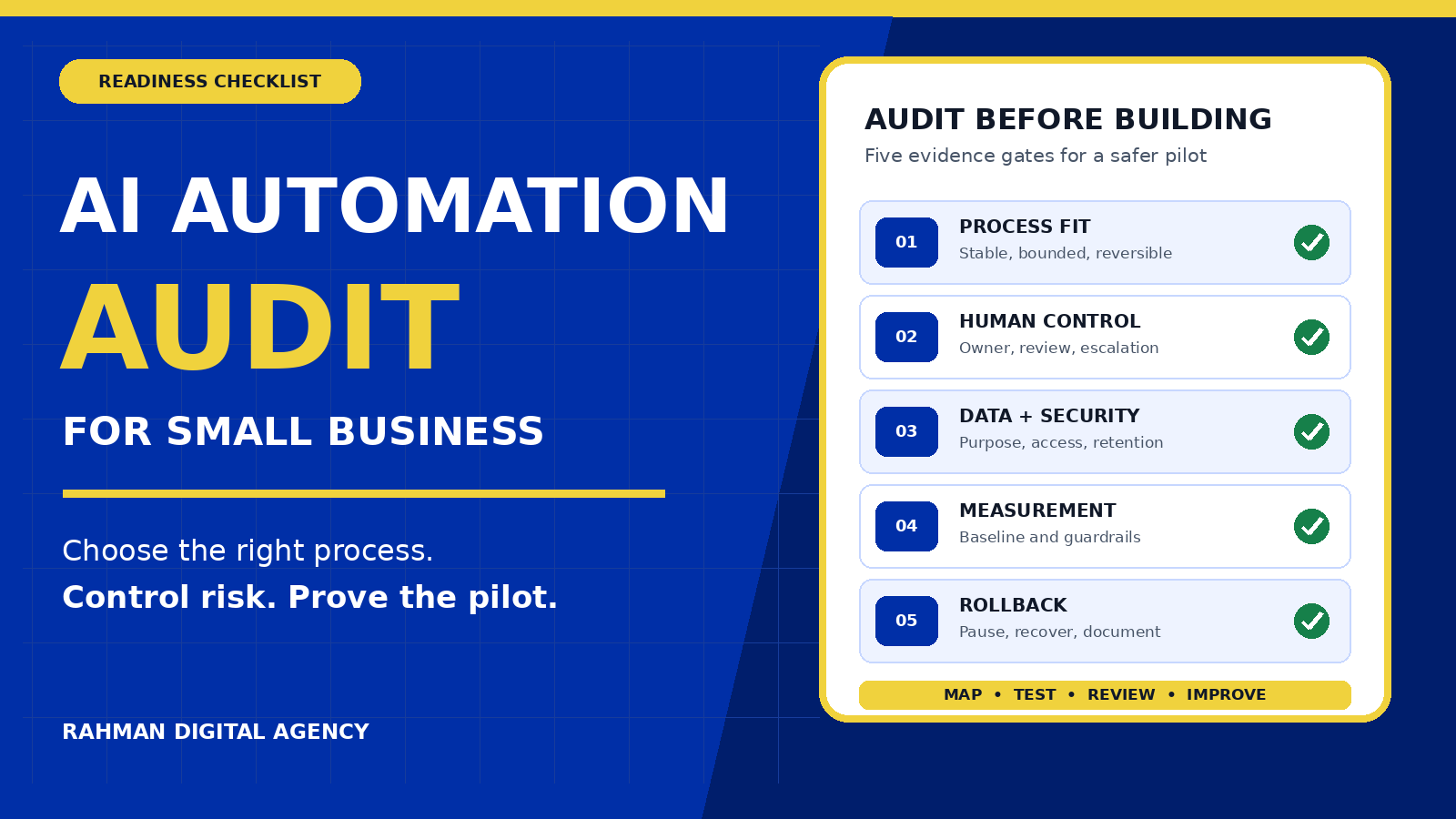
AI automation audit checklist for small business covering process fit, human control, data security, measurement and rollback in RDA blue and gold

Small-business readiness guide

An AI automation audit for small business should answer a harder question than “Which tool should we buy?” It should show which process is worth automating, what could go wrong, who remains accountable, what evidence proves the pilot works, and how the business can stop or reverse it safely.

The practical answer: choose one bounded workflow, score its process fit, inspect the data and integrations, define human approval and exception routes, record a baseline, and run a reversible pilot. A process with high volume but unclear rules, poor data, or serious consequences is not “AI-ready” merely because software can connect to it.

What an AI automation audit should cover

A useful audit is a business-and-operations review before implementation. It is not a software demo, a prompt-writing exercise, or a promise that artificial intelligence will fix an unclear process. The output should help an owner decide what to automate now, what to improve first, and what not to automate.

For a small business, the audit normally covers five connected layers:

Process

Volume, repetition, rule clarity, handoffs, exceptions and consequences when the workflow is wrong.

People

Ownership, approval points, escalation, training, override rights and the customer experience.

Data

Source quality, permissions, sensitivity, retention, access and whether records are usable.

Technology

APIs, authentication, integration limits, monitoring, costs, dependencies and rollback.

Evidence

Baseline metrics, acceptance criteria, logs, exceptions, change records and review dates.

Risk

Financial, operational, privacy, security, legal, reputational and customer-impact scenarios.

This structure follows the same practical logic as established guidance. The NIST AI Risk Management Framework organises risk work around Govern, Map, Measure and Manage. The U.S. Small Business Administration’s AI guidance also emphasises identifying suitable uses, considering benefits and risks, protecting sensitive information and establishing responsible use.

The 10-part AI automation readiness scorecard

Score a candidate workflow from 0 to 2 against each factor: 0 = not ready, 1 = partly ready, and 2 = ready with evidence. The total is a prioritisation aid—not a safety or compliance certificate.

FactorQuestion to testEvidence to request
1. Clear outcomeCan the team state the desired result without naming a tool?One-sentence outcome and scope boundary
2. Stable processIs the current workflow documented and reasonably consistent?Process map, sample cases and exception list
3. Sufficient volumeDoes the task happen often enough to justify build and maintenance effort?Monthly case volume and time per case
4. Rule clarityCan a reviewer explain ordinary decisions and escalation rules?Decision table and approval thresholds
5. Reversible actionCan an incorrect output be stopped, corrected or rolled back?Pause switch, rollback steps and owner
6. Usable dataAre required records accurate, complete, current and permitted for this purpose?Sample audit, field definitions and permissions
7. Integration accessCan systems exchange data reliably without shared passwords or manual copying?API availability, authentication model and limits
8. Human controlWho reviews sensitive, unusual, high-value or low-confidence cases?Approval matrix and escalation route
9. Measurable baselineCan the business compare the pilot with current performance?Time, cost, error, completion and exception rates
10. Accountable ownerWho owns results, incidents, vendor decisions and ongoing review?Named process owner and review calendar
How to interpret the result

0–8 Fix the process, data or ownership before building. 9–15 Consider a narrow assisted pilot with close review. 16–20 The workflow may be ready for a controlled pilot, subject to risk, legal, privacy and security review appropriate to the use case.

Do not average away a critical failure. A workflow can score well overall and still be unsuitable if it handles sensitive data without authority, makes high-consequence decisions without review, or cannot be stopped when an integration fails.

1. Choose a process, not an impressive tool

The strongest first project is usually repetitive, bounded, observable and reversible. Examples include classifying a low-risk inbound request, drafting an internal summary for review, routing a lead according to documented rules, reminding staff about incomplete records, or assembling a scheduled operational report.

A weak candidate has an unstable process, rare volume, undefined ownership, undocumented exceptions, or consequences that are difficult to reverse. Automating a confusing workflow can make the confusion faster and less visible.

Map the current workflow before designing the future one

  • Write the trigger: what event starts the work?
  • List every required input and its source.
  • Record the ordinary decisions and the person who makes them.
  • Collect at least ten normal cases and several difficult exceptions.
  • Identify every customer-facing message or irreversible action.
  • Measure waiting time, active work time and rework.
  • Define where the automated workflow must stop and request help.

If the goal is primarily time reduction, compare this audit with our earlier guide on how AI automation can reduce repetitive small-business work. The audit described here has a different purpose: deciding whether a specific process is ready and what controls it requires.

2. Keep a named human in control

“Human in the loop” is useful only when the loop is specific. Someone must know what they are reviewing, when review is mandatory, how much context they receive, and what to do when the system is uncertain or wrong.

Define at least four roles:

  • Process owner: accountable for the business outcome and customer impact.
  • System owner: accountable for integrations, credentials, monitoring and changes.
  • Reviewer: approves defined outputs or exceptions before action.
  • Incident contact: can pause the workflow, contain damage and coordinate recovery.

Set explicit approval gates for high-value purchases, financial changes, contract or legal communications, employment decisions, sensitive personal data, account changes and messages that could materially affect a customer. A lower-risk internal draft may need sampling rather than approval on every case, but the owner should document that decision.

Do not hide responsibility behind the software. A vendor can provide a model, platform or connector. The business still needs to decide whether the workflow is appropriate, who can use it, which data can enter it and how outputs are checked.

3. Review privacy, security and vendor boundaries

Before connecting a model or automation platform, inventory the exact data fields that will move through it. “Customer data” is too vague. Name the fields: email address, order value, message content, health information, payment status, uploaded files, or internal notes.

The UK Information Commissioner’s Office guidance on AI and data protection covers accountability, lawful basis, fairness, transparency, security, data minimisation and individual rights. Requirements differ by jurisdiction and use case, so businesses should obtain appropriate professional advice rather than treating a tool’s marketing page as a compliance decision.

Questions for each system and vendor

  • What data is sent, and is every field necessary for the stated purpose?
  • Where is the data processed and stored?
  • Is input used to train or improve a shared model, and can that use be disabled?
  • How long are inputs, outputs and logs retained?
  • Who can access production data and administrative settings?
  • Which credentials are used, and can permissions be limited to the minimum required?
  • How are deletion, access requests, incidents and vendor termination handled?
  • Can the business export its configuration, logs and data before leaving?

The UK AI Cyber Security Code of Practice provides lifecycle-oriented security guidance. For a small-business pilot, practical controls include least-privilege access, separate test and production credentials, protected secrets, dependency review, logging, an incident route and a tested shutdown procedure.

4. Test the data before trusting the workflow

Automation quality depends on source quality. A workflow that reads duplicated contacts, inconsistent statuses or outdated product data may produce polished but unreliable results.

The UK Government Data Quality Framework describes dimensions including accuracy, completeness, uniqueness, consistency, timeliness and validity. Translate them into concrete tests:

DimensionSmall-business testExample failure
AccuracyCompare a sample with an authoritative source.The CRM shows an old customer status.
CompletenessMeasure missing required fields.Leads lack a service area or consent record.
UniquenessCheck for duplicate people, orders or tasks.The same enquiry triggers two follow-ups.
ConsistencyCompare formats and definitions across systems.“Closed” means won in one tool and finished in another.
TimelinessMeasure delay between the real event and the record.Stock or appointment availability is stale.
ValidityTest values against permitted formats and ranges.A date, email or amount cannot be processed safely.

Assign an owner to each critical field. If no one can explain where a value comes from, when it changes or how an error is corrected, the automation is not ready to depend on it.

5. Map integrations, limits and failure modes

A reliable automation is more than a model response. It may depend on a website form, CRM, email provider, calendar, file store, payment system, messaging platform and reporting database. Each connection adds permissions, limits and failure states.

Create a simple system diagram showing the trigger, data movement, decision points, outputs and logs. Then ask what happens if each component is slow, unavailable, duplicated or returns an unexpected format.

Minimum failure-mode checklist

  • Duplicate event: prevent a second message, invoice or CRM record.
  • Missing field: stop or route to review rather than inventing a value.
  • Timeout: retry only when the action is safe to repeat.
  • Partial success: record which steps completed before recovery begins.
  • Permission failure: alert an owner without exposing credentials in logs.
  • Unexpected output: validate structure and allowed values before downstream action.
  • Vendor outage: define whether work waits, falls back to manual handling or is cancelled.
  • Bad release: keep a known-good version and written rollback steps.

Related implementation guides show how these principles apply to particular workflows, including lead qualification and routing, client reporting, and client onboarding. Use them as workflow examples, not as permission to copy a design without adapting its controls.

6. Record a baseline before the pilot

If the business does not measure the current process, it cannot distinguish improvement from novelty. Take a representative sample before implementation and record:

  • Cases completed per week or month
  • Median active work time and waiting time
  • Error, rework and exception rates
  • Completion or response time
  • Staff effort and direct operating cost
  • Customer complaints, corrections or drop-offs
  • Revenue or conversion outcomes only where attribution is defensible

Choose metrics that match the workflow. A lead-routing pilot should not be judged only by the number of messages sent. It may need routing accuracy, time to first response, duplicate rate, qualification completeness, opted-out contact rate and qualified-opportunity outcomes.

Define a guardrail beside every success metric. Faster processing is not an improvement if corrections, complaints or privacy risk increase.

7. Design a reversible pilot with acceptance criteria

Start with a limited scope: one process, one team, one data source, one output channel and a defined review period. Keep the manual route available until the automated route has evidence.

Write acceptance criteria before launch

Example for an internal enquiry-classification pilot:

  • At least 95% of required fields reach the review queue intact.
  • No customer message is sent without a named reviewer’s approval.
  • Every low-confidence or unsupported category is routed to manual review.
  • No duplicate task is created for the same source enquiry.
  • The owner receives an alert within five minutes of a stopped workflow.
  • The team can disable the automation and resume the manual process within fifteen minutes.

These are illustrative thresholds, not universal standards. Set values from the process risk, current baseline and business tolerance. Test normal cases, edge cases, malformed inputs, permission failures and duplicate events.

Use versioned test cases. When the prompt, model, rule, integration or source schema changes, rerun the same set. This turns “it looked fine in a demo” into reproducible evidence.

8. Build an audit evidence pack

The OECD AI Principles emphasise accountability and traceability across the AI lifecycle. For a small business, traceability does not require an enormous governance programme. It does require enough evidence to understand what happened and respond when something goes wrong.

Keep a practical evidence pack containing:

  • The approved purpose, owner, scope and prohibited uses
  • A current process and data-flow map
  • Vendor and integration inventory
  • Data-field list, access roles and retention decisions
  • Baseline metrics and pilot acceptance criteria
  • Versioned prompts, rules, schemas and workflow exports
  • Test cases, expected results and actual results
  • Approval, exception and incident logs
  • Known limitations and user instructions
  • Rollback procedure and proof that it was tested
  • Review date and change owner

Logs should be useful without becoming a new privacy or security problem. Avoid recording secrets, unnecessary personal data or complete payloads when an event ID and safe diagnostic information are enough.

Which workflows should a small business audit first?

Start where commercial value and operational clarity overlap. The following order is often more defensible than starting with the most visible customer-facing decision.

CandidateWhy it may fitMain audit concern
Internal reporting assemblyRepeatable, observable and usually reversibleSource freshness, definitions and misleading summaries
Lead routing for reviewClear fields and measurable response timeBias, missing context, duplicates and missed high-value cases
Follow-up remindersHigh frequency with defined timingConsent, suppression, tone and over-messaging
Document or call summariesUseful draft output with human verificationConfidentiality, omissions and invented details
Invoice-status remindersRules may be clear and outcomes measurableIncorrect balances, disputes and customer escalation
High-impact decisionsPotentially valuable but consequence is seriousUsually unsuitable as a first autonomous project; requires deeper review

Red flags that should pause implementation

  • The project is defined as “add AI” rather than solve a measured problem.
  • No one owns the current process or the future output.
  • The team cannot produce representative normal and exception cases.
  • A vendor needs broad administrator access without a clear reason.
  • Sensitive or personal data will be copied before purpose, permission and retention are reviewed.
  • The proposed workflow can send, pay, delete, approve or change accounts with no human gate.
  • There is no duplicate protection, output validation or alerting.
  • Success is described only as hours saved, with no quality or risk guardrail.
  • The business cannot export configuration, logs or a rollback version.
  • A supplier promises perfect accuracy, guaranteed savings or automatic compliance.

A practical 30-day AI automation audit plan

Week 1: discover and measure

Select one workflow. Interview the people who perform and receive the work. Map inputs, decisions, handoffs, exceptions and outputs. Measure a baseline from real cases. List candidate risks and data fields.

Week 2: design controls

Define the owner, reviewer, approval gates, access model, retention, validation rules, alerts and rollback. Review vendor terms and the need for privacy, legal or security advice. Decide what the pilot is explicitly prohibited from doing.

Week 3: build in a safe environment

Use test data or appropriately protected samples. Keep secrets outside workflow code. Validate every output before action. Create versioned test cases for normal, edge and failure scenarios. Document the known-good configuration.

Week 4: run and review

Operate the pilot with limited scope and human review. Compare it with the baseline. Record corrections, exceptions, incidents and staff feedback. Continue, revise or stop based on the criteria agreed before launch.

A sensible audit can conclude “not yet.” Improving the source process, cleaning the CRM, defining ownership or reducing permissions may create more value than rushing into production automation.

Frequently asked questions

How long does an AI automation audit take?

A narrow workflow can often be mapped and assessed within days, while a multi-system or sensitive-data process requires longer. The schedule should depend on scope, evidence availability, risk and the number of people and systems involved—not a fixed marketing promise.

Does a small business need AI governance?

It needs governance proportionate to the use. At minimum, define purpose, ownership, permitted data, access, review, monitoring, incident handling and change control. A low-risk internal drafting aid needs less control than a workflow affecting customers, money, employment or sensitive data.

What is the best first AI automation?

There is no universal best workflow. A strong first candidate is frequent, bounded, measurable, reversible and supported by usable data. Internal assistance with review is often safer than an autonomous high-impact customer action.

Can the audit prove ROI before implementation?

No. It can establish a baseline, estimate implementation and operating costs, identify assumptions and define a pilot that measures actual results. Treat forecasts as scenarios, not guarantees.

Is this a legal or compliance audit?

No. This operational readiness checklist does not replace legal, privacy, cybersecurity, employment or sector-specific professional advice. Obtain the review appropriate to the data, jurisdiction and consequences of the planned use.

Turn one candidate workflow into a safe pilot roadmap

Rahman Digital Agency can help map the process, prioritise controls, design the integration, define test evidence and plan a reversible pilot. Review our AI Automation Services, then share the workflow you want to assess.

Request an AI automation readiness discussion

This readiness checklist is educational, not legal, privacy, cybersecurity or regulatory advice. Obtain appropriate professional advice before automating sensitive-data or regulated workflows.