
Posted on

Local SEO Pricing: What US Small Businesses Should Pay For—and Avoid

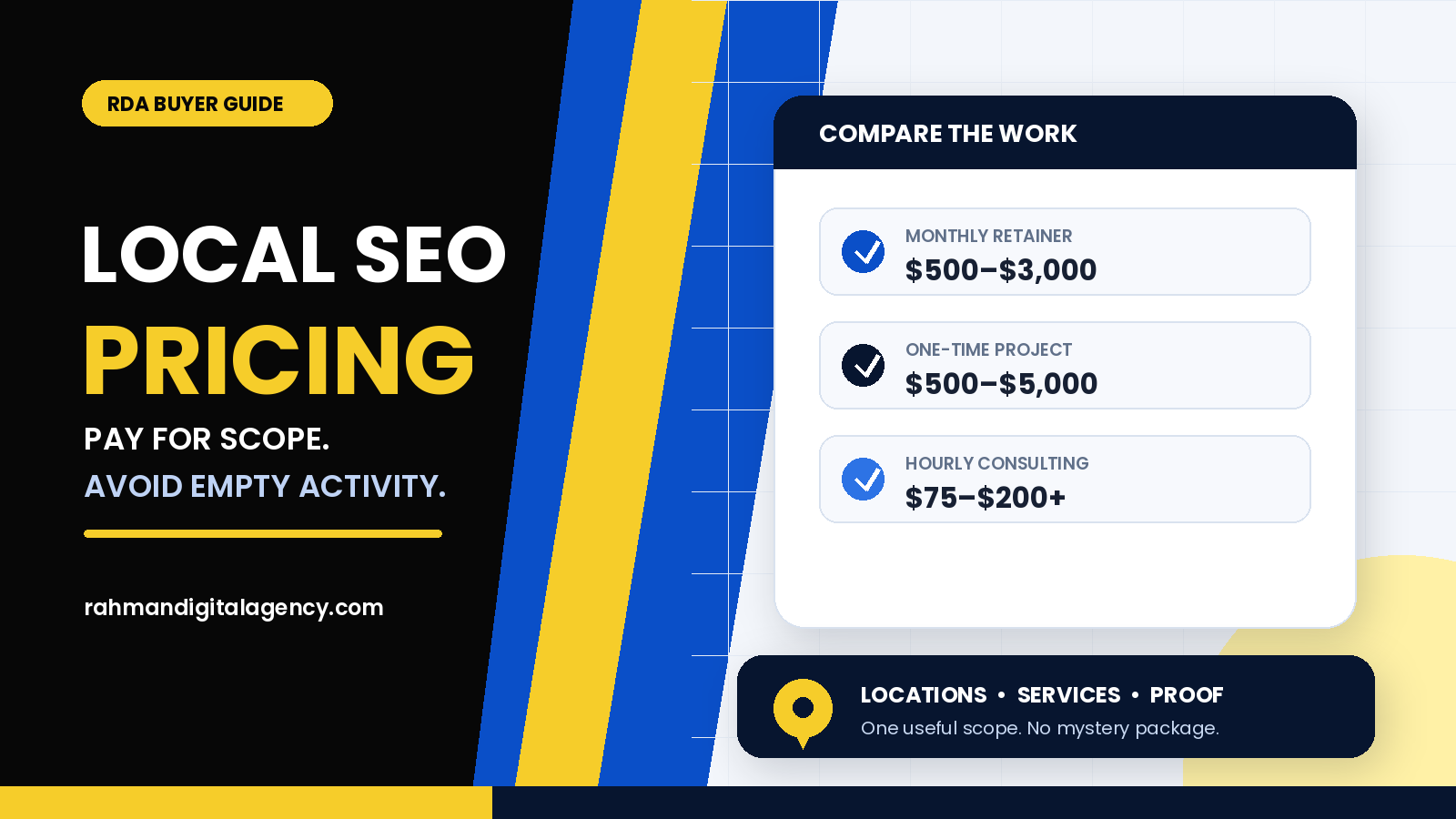
Local SEO pricing buyer guide showing monthly retainers, one-time projects and hourly consulting ranges

US small-business buyer guide

Local SEO pricing makes sense only when the scope names the locations, services, pages, listings, reviews, technical work and reporting included. Compare the work—not just the monthly fee.

The short answer: current public industry guidance commonly places agency retainers around $500 to $3,000 per month, one-time local SEO projects around $500 to $5,000, and experienced consulting around $75 to $200+ per hour. These are broad third-party reference ranges, not a universal rate card or a Rahman Digital Agency quote.

A single-location business in a modest market may need much less work than a multi-location company competing across dense metro areas. The useful question is not “What is the cheapest package?” It is “What work is required to make each important location and service genuinely easier to find and choose?”

Local SEO helps a business improve visibility for searches connected to a geographic area—such as “dentist near me,” “roof repair in Austin,” or a branded search that opens a Google Business Profile. The work can span the profile, website, business listings, reviews, local content, technical foundations and measurement.

This guide is for US small-business owners comparing providers. It shows how to interpret pricing, identify missing scope, normalize proposals and avoid paying for activity that cannot be connected to a real location, service or customer journey.

What does local SEO cost?

Published ranges vary because “local SEO” is not a fixed bundle. WebFX reports an average of $500–$3,000 per month for retainers, $500–$5,000 for one-time projects and $75–$200+ per hour for consulting. SEO.com describes agency services generally ranging from $500–$2,000 per month, while also noting that location count, geography, scope and support affect the price.

How to use those figures: treat them as orientation, not a quote calculator. A provider should still explain the work, assumptions, deliverables and measurement behind your price. A low fee can be sensible for a narrow scope; it becomes risky when it quietly excludes essentials.

Pricing modelTypical useWhat to clarifyMain risk
Monthly retainerOngoing optimization, content, listings, reputation support and reportingMonthly priorities, included locations, deliverables, approvals and cancellation termsPaying for repetitive activity without a location-specific plan
One-time projectAudit, profile cleanup, location-page build, citation correction or migration supportHandover, implementation responsibility, acceptance checks and post-project supportReceiving recommendations that nobody implements
Hourly consultingSpecialist advice, internal-team guidance, troubleshooting or quality reviewExpected hours, outputs, meeting time and documentationOpen-ended time without agreed deliverables
Performance-linked feeOccasionally used with an underlying base scopeMetric definition, attribution, baseline, exclusions and data accessIncentives tied to rankings or leads the provider cannot fully control

What changes a local SEO quote?

Number of real locations

Each eligible location may need profile management, landing pages, listings, review processes, local links and reporting. Ten locations are not simply one location copied ten times.

Market competition

A specialist in a small service area faces a different search landscape from a law firm, clinic or home-service brand competing across a major metro.

Service breadth

One core service requires a smaller information architecture than many services with different customer intent, evidence and conversion paths.

Starting condition

Duplicate profiles, inconsistent business information, thin location pages, technical defects or a history of low-quality tactics increase cleanup work.

Content and authority needs

Useful service and location content, local partnerships, digital PR and link earning demand more research and editorial effort than simple metadata edits.

Internal capacity

Pricing changes when your team supplies copy, photos, approvals, review responses and developer time rather than asking the provider to own them.

What should a local SEO package include?

A credible scope should connect each activity to a real customer decision. Not every business needs every item every month, but exclusions should be explicit.

Google Business Profile work

Category selection, services, hours, contact details, attributes, photos, posts where useful, question-and-answer monitoring and duplicate-profile review. The business should retain ownership and grant access rather than surrendering control.

Local keyword and intent mapping

The provider should map important services and locations to the right page type. A profile, service page, location page and educational article solve different search needs.

Website and technical foundations

Indexability, mobile usability, crawl paths, internal links, titles, canonicals, page speed, structured data and conversion paths should be reviewed. Our SEO audit checklist for service-business websites provides a broader technical and lead-protection review.

Service and location pages

Pages should contain useful, specific evidence for the people served in that area. Swapping a city name across near-identical pages is not a durable content strategy.

Business listings and citation consistency

Core name, address, phone and website information should be accurate on important platforms. The objective is trustworthy business data, not an impressive count of low-value directory submissions.

Review process and reputation support

The scope may include compliant review-request workflows, response guidance and issue escalation. It should never include fabricated reviews, review gating or promises to remove legitimate criticism.

Local authority building

Relevant chambers, associations, suppliers, sponsorships, community resources, partnerships and local media can create useful mentions and links. Quality and relevance matter more than bulk placement.

Measurement and business reporting

Reports should separate visibility indicators from business outcomes. Useful views can include profile actions, calls where lawfully tracked, form submissions, landing-page performance and qualified enquiries—not rankings alone.

Google explains that local results are mainly based on relevance, distance and prominence. A responsible plan therefore improves how clearly the business matches a search, represents its real locations accurately and strengthens trustworthy signals. No provider can change the searcher’s physical distance or guarantee a particular map position.

How much should your business budget?

Start with the economics of one service area rather than copying another company’s marketing percentage. Use a simple planning model:

Affordable monthly acquisition cost = target qualified customers × acceptable cost to acquire one customer

That figure is a ceiling for the combined acquisition system—not automatically the SEO retainer. It may also need to cover website changes, call tracking, creative, paid media, software and sales follow-up.

Then match the SEO scope to four questions:

  1. Which locations and services matter most? Prioritize the combinations with real capacity, margin and customer value.
  2. What is broken or missing now? Separate cleanup work from ongoing growth work.
  3. What can your team reliably supply? Photos, subject expertise, approvals and review responses reduce delays only when ownership is clear.
  4. How will value be judged? Define qualified enquiries and sales handoff before selecting dashboard metrics.

Practical approach: a smaller business can begin with one location, a focused service set and a defined ninety-day foundation. Expansion should follow verified capacity and evidence—not a package designed for locations or services the business does not operate.

How to compare local SEO proposals

Give each shortlisted provider the same business information: locations, service areas, priority services, current website, profile access status, known problems, internal resources and desired customer actions. Then compare the replies line by line.

Comparison itemProvider AProvider BProvider CEvidence or notes
Locations and services includedExact list?
Initial audit and cleanupFindings plus implementation?
Google Business Profile scopeOwnership and access?
Service/location pagesResearch, writing and approval?
Technical implementationWho changes the site?
Listings and citationsPlatforms and correction process?
Reviews and reputationCompliant method?
Local links and mentionsRelevance and quality controls?
Measurement and reportingQualified-enquiry definition?
Meetings and response timesNamed owner?
Contract and cancellationMinimum term and notice?
One-time and recurring feesSoftware or media extra?
Account and asset ownershipBusiness-controlled accounts?

Local SEO pricing red flags

  • Guaranteed map-pack or first-position rankings. Search results vary by query, location, competition and other signals.
  • A package with no named locations or services. Generic activity makes accountability difficult.
  • Bulk location pages with only city names changed. Near-duplicate pages can be unhelpful to users and weak as long-term assets.
  • Hundreds of directory submissions sold as the main strategy. Important, accurate listings are more useful than raw volume.
  • Fake reviews, review gating or ownership shortcuts. These create platform, reputation and access risk.
  • Reports built only around rankings. Visibility matters, but the business ultimately needs relevant calls, forms, visits and sales conversations.
  • The provider owns your profile, analytics or website account. Your business should keep control and grant revocable access.
  • No implementation boundary. An audit has limited value when nobody is responsible for making and testing changes.

Questions to ask before signing

  • Which exact locations and services are included?
  • What will happen in the first 30, 60 and 90 days?
  • Which work is one-time and which repeats monthly?
  • Who writes, approves and publishes content?
  • Who implements technical recommendations?
  • How are duplicate or suspended profiles handled?
  • How will review requests stay compliant?
  • What local-link tactics are prohibited?
  • Which accounts will the business own?
  • How are calls, forms and qualified enquiries defined?
  • What software or third-party fees are separate?
  • What contract term and cancellation notice apply?
  • What evidence will show work was completed?
  • How will the plan change if a location lacks capacity?

Frequently asked questions

Is $500 per month enough for local SEO?

It can be enough for a tightly defined scope, especially for one location with sound foundations and modest competition. It is unlikely to fund deep technical fixes, extensive content, active authority building and multi-location support at the same time. Ask what is included and what remains your responsibility.

Why do multi-location businesses cost more?

Each real location may need distinct profile management, landing-page evidence, listings, reviews, internal links, local partnerships and reporting. Efficient systems can reduce duplication, but each location still needs accurate information and useful local relevance.

How long should a local SEO contract be?

The contract should be long enough to complete the agreed work and evaluate meaningful indicators, but it should not hide weak accountability. Review milestones, access, reporting, cancellation terms and asset ownership before signing. Ask what remains usable if the engagement ends.

Should local SEO include Google Business Profile management?

For most location-based businesses, the profile is an important part of the system. The exact monthly activity varies, but categories, services, hours, contact details, photos, reviews, duplicates and access should be addressed. The business should remain the owner.

Can a provider guarantee calls or rankings?

No provider controls every search result, competitor action, customer decision or sales outcome. A credible provider can commit to defined work, transparent methods, implementation quality and measurement. Treat guarantees of a specific ranking or lead count with caution.

When is a one-time project better than a retainer?

A one-time project can fit a clear audit, profile cleanup, citation correction, tracking setup or location-page build when your team can maintain the result. Ongoing competition, content, reviews, technical changes and multiple locations may justify continuing support.

Sources and further reading

Need a scope-based SEO conversation?

Rahman Digital Agency provides SEO services for businesses that need clearer priorities, implementation and measurement. Send your website, target locations and priority services, and we can discuss the scope before an estimate is prepared.
Posted on

SEO Audit Checklist for Service Business Websites: 25 Checks That Protect Leads

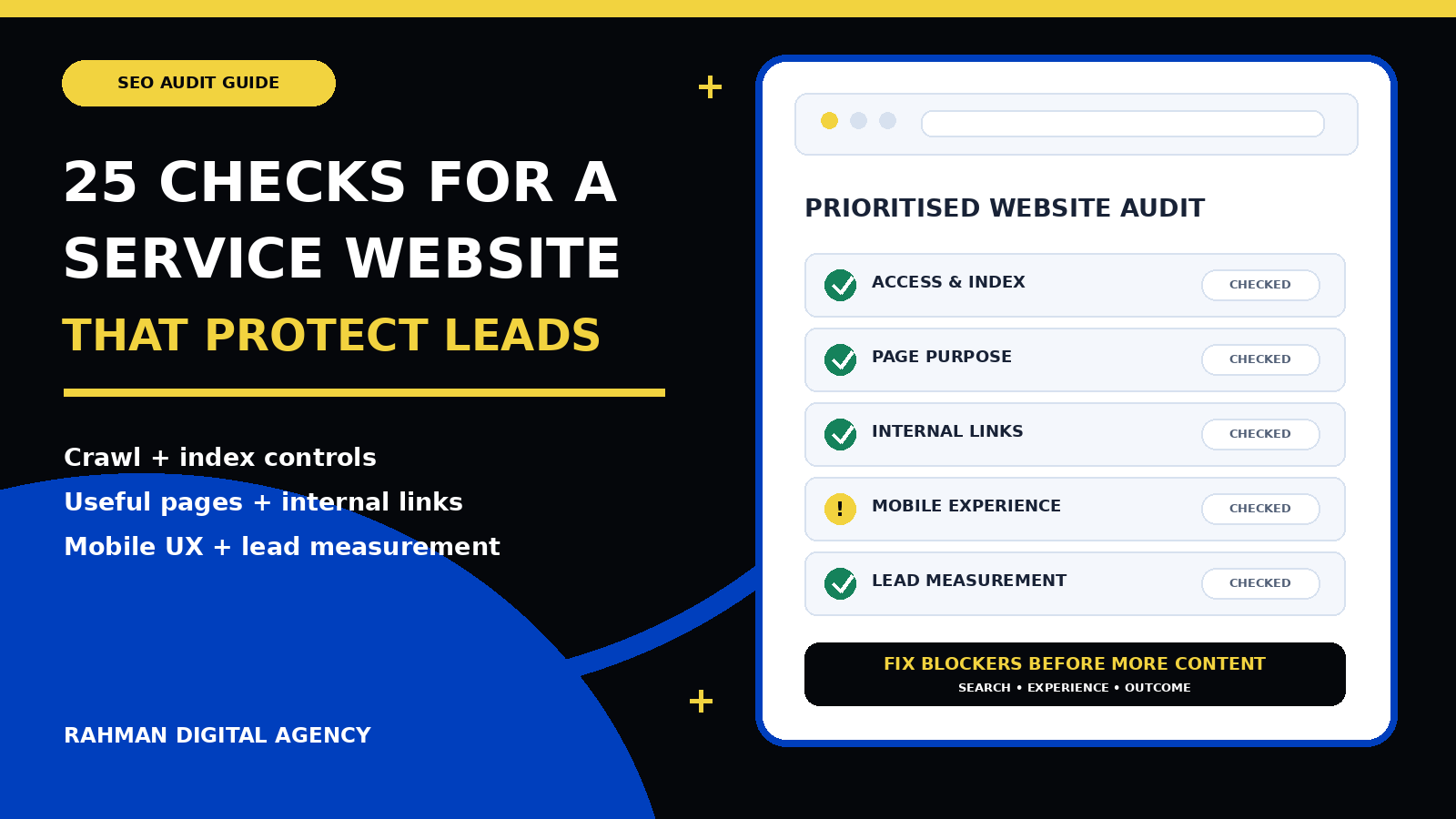
SEO audit checklist dashboard covering access, page purpose, internal links, mobile experience and lead measurement

SEO and lead-generation audit

A useful SEO audit does more than list technical warnings. It shows whether search engines can access the right pages, whether those pages answer a real customer need, and whether organic visitors can become qualified enquiries.

How to use this checklist: audit one representative service journey from search result to enquiry, then expand the review across the site. Record evidence for every finding, separate urgent blockers from opportunities, and fix measurement before judging whether content or traffic is producing useful business outcomes.

Service-business SEO can look healthy while quietly underperforming. A site may have hundreds of indexed URLs but no clear page for its most valuable service. A page may attract impressions but send visitors to an unclear next step. A form may appear to work yet fail to create a reliable sales record. Publishing more articles does not repair those faults.

This 25-point SEO audit checklist is designed for agencies, consultancies, professional services, local operators and other businesses that depend on enquiries rather than an immediate online purchase. It combines search accessibility, page quality, information architecture, user experience and lead measurement. If your website also needs a stronger commercial journey, use it alongside RDA’s guide to building a lead generation website for a service business.

Start with a small, evidence-based audit scope

Do not begin by exporting every warning from every tool. First identify the services that matter, the pages intended to represent them, and the actions a suitable prospect should take. Choose a sample that includes the homepage, one core service page, one supporting article, one proof page and the contact or booking path. This gives the audit a customer journey rather than a random collection of URLs.

Business layer

Which services, locations and customer types are priorities? What makes an enquiry suitable, and which page should help that visitor decide?

Search layer

Which pages appear in search, for which queries, and with what clicks, impressions and landing-page behaviour?

Experience layer

Can a mobile visitor understand the offer, inspect relevant proof and complete the next step without obstruction?

Operations layer

Does a completed enquiry reach the correct person or system, retain useful source context and receive a recorded outcome?

Keep findings reproducible: record the URL, device, test method, observed result and expected result. “SEO issue” is not a useful ticket. “The canonical on the plumbing service page points to the homepage in the public HTML” is specific enough to verify and fix.

Phase 1: Crawlability and index control

Confirm that search engines can reach the right public pages and are not being directed toward the wrong versions.

Check the final HTTP status and crawl path

Every important public page should resolve to the intended URL and return a successful status. Follow redirects from internal links, old URLs, HTTP versions and common campaign links. Long redirect chains waste time for people and crawlers; redirect loops and soft error pages can hide the destination entirely.

Google’s technical requirements describe access by Googlebot, a successful HTTP status and indexable content as basic eligibility conditions. These are entry requirements, not a complete quality assessment.

Practical test: request each priority URL logged out, record the complete redirect chain, and compare the final page with the destination used in navigation, sitemaps and canonical tags.

Review robots.txt, meta robots and response headers

Check whether the site blocks crawling in robots.txt, applies a page-level noindex, or sends an X-Robots-Tag header. A staging rule, template setting or plugin option can exclude commercially important pages without changing their appearance.

Google’s robots meta documentation explains how page and resource directives affect indexing and presentation. Review the live response rather than relying only on an editor checkbox.

Practical test: inspect the raw HTML and response headers for the homepage, service pages, articles, PDFs and other indexable assets. Confirm that intentionally excluded account, cart, search or utility pages remain excluded.

Verify canonical URLs and duplicate versions

A canonical tag should identify the preferred version of a page. Check protocol, hostname, trailing slash, parameters, pagination, print views and other duplicates. A canonical that points to an unrelated page can cause the wrong URL to be treated as representative.

Canonical tags are signals, not a substitute for consistent architecture. Google’s canonicalization guidance recommends aligning signals such as redirects, canonicals and sitemap URLs.

Practical test: compare the canonical in public source with the browser URL, sitemap entry and preferred internal links. Sample normal and parameterised URLs rather than checking only one page.

Audit XML sitemaps for preferred, live pages

A sitemap should contain clean canonical URLs that are useful to discover. Remove redirected, broken, duplicate, private or intentionally non-indexable entries. Split large or operationally different groups when that makes ownership and diagnosis clearer.

Google notes in its sitemap guidance that submitting a sitemap is a hint. It does not override weak pages, contradictory directives or broken navigation.

Practical test: crawl every submitted sitemap URL, compare status, canonical and robots state, then identify important canonical pages that are absent.

Confirm mobile content and metadata parity

Important service details, headings, links, images, structured data and metadata should not disappear on the mobile version. Accordions are acceptable when their content remains available and usable; removing essential proof or navigation to simplify a layout is not.

Google’s mobile-first indexing guidance emphasises equivalent content and signals on mobile. Audit with the actual rendered mobile page, not only a desktop crawler.

Practical test: compare desktop and mobile DOM, visible text, links, image alt text, canonicals, robots directives and structured data for representative templates.

Phase 2: Page purpose, intent and content quality

Make sure each important URL has a distinct job and helps the visitor make a real decision.

Assign one primary purpose to every important page

A service page should explain and convert that service. A guide should answer a defined question and connect the reader to a relevant next step. A case study should provide verifiable context and proof. When several URLs target the same purpose, they may compete, confuse internal linking and divide maintenance effort.

Practical test: create a page map with URL, audience, primary question, target action and owner. Flag duplicate purposes and pages with no useful role.

Check titles, visible headings and descriptions as a set

The document title should identify the page clearly in search and browser tabs. The visible main heading should confirm that destination to the visitor. The description should summarise the value accurately rather than repeating the same phrase or making unsupported promises.

Check the rendered page for theme-inserted or hidden duplicate headings. A page can contain two H1 elements in source while only one is visible—or hide a real duplicate with layout rules. Geometry and visibility matter.

Practical test: review title length and clarity, one visible main heading, descriptive subheadings, and whether the search snippet promise matches the opening content.

Match the page to the customer’s search intent

Search intent is not just a keyword label. A person comparing agencies needs scope, ownership, process, proof and evaluation criteria. Someone diagnosing a tracking problem needs a test path. A buyer requesting a quote needs service fit and a low-friction next step.

Use Search Console queries, sales questions, internal search and customer conversations to understand the decision behind the wording. Do not force an informational article to perform the job of a service page or vice versa.

Practical test: read the page from the perspective of the query. Can the visitor understand within the opening section that the page addresses their situation and what they can do next?

Assess whether the content is genuinely useful and complete

Useful content gives the reader enough context to act: definitions, boundaries, examples, steps, trade-offs and a route to deeper information. Thin pages often repeat broad claims, add place names to a template, or summarise a topic without resolving the decision.

Google’s guidance on helpful, reliable, people-first content asks whether material serves an intended audience and demonstrates first-hand expertise and depth. Use those questions as an editorial review, not a box-ticking score.

Practical test: highlight sentences that help the customer decide or complete a task. Rewrite or remove sections that exist only to repeat terminology.

Verify claims, proof and business information

Confirm service areas, credentials, case-study outcomes, prices, dates, product capabilities and team information. Add source context where a claim depends on an external authority. Replace unqualified “best,” “guaranteed” and universal outcome language with accurate scope and relevant evidence.

Proof should match the decision. A project example is more helpful when it explains the starting problem, work completed and limitations than when it shows only a logo. Ownership and access details also matter: the client should know what they retain after an engagement.

Practical test: give every material claim an owner, evidence source and review date. Remove claims that cannot be supported.

Phase 3: Service architecture and internal links

Help visitors and crawlers move from broad context to a specific service, supporting proof and a clear next step.

Map core services to dedicated, substantial pages

Commercially important services usually need distinct pages when they solve different problems, involve different deliverables or support different customer decisions. Avoid one generic “services” page that mentions everything briefly, but also avoid splitting one service into several near-identical URLs.

Use RDA’s website design and development service as an example of a commercial destination that supporting guides can reference. The service page should own the main commercial intent; articles should answer narrower questions.

Practical test: connect every priority service to one canonical service page, one primary conversion action and relevant proof.

Review contextual internal links and anchor text

Internal links should help a reader take the next logical step. Use descriptive anchor text that explains the destination. Link supporting articles to the relevant service page, and link service pages to proof and useful guides where that improves the decision.

Google’s SEO Starter Guide recommends logical organisation and descriptive links. Navigation menus matter, but contextual links show the relationship between a specific question and its answer.

Practical test: inspect inbound and outbound links for each priority page. Replace vague repeated anchors such as “learn more” when a descriptive phrase is natural.

Find orphaned and buried pages

An orphan page has no useful internal route from the site. A buried page may require many clicks through archives or filters. Sitemaps can assist discovery, but they do not create a coherent customer journey.

Practical test: compare a crawl of internal links with the sitemap and analytics landing pages. Investigate useful URLs found only through the sitemap, external links or historic traffic.

Use readable URLs, navigation and breadcrumbs

URLs should remain stable, concise and meaningful enough to identify the page. Navigation should reflect how customers explore the offer rather than the organisation chart. Breadcrumbs can provide context on deeper content, particularly where several service or resource groups exist.

Do not change established URLs merely to insert a phrase. A URL migration requires redirects, updated internal links, refreshed canonicals and testing. If a wider rebuild is planned, follow a website redesign SEO checklist before launch.

Practical test: identify confusing or unstable patterns, but create a migration case only where the long-term benefit outweighs redirect and traffic risk.

Consolidate duplicate, thin and templated location pages

Location pages are useful when the business genuinely serves those areas and can provide distinct, accurate information. Pages created by swapping a city name while keeping the same generic copy rarely help a buyer. Similar service variants may also belong on one strong page unless the customer decision differs materially.

Practical test: group pages by title, headings and text similarity. Keep, improve, merge or redirect them according to purpose, demand, backlinks and business relevance.

Phase 4: Mobile experience, speed and page semantics

Search visibility is less valuable when the public page is slow, unreadable or blocks the next step.

Measure Core Web Vitals with field and lab evidence

Google’s Core Web Vitals guidance identifies good-experience thresholds of Largest Contentful Paint within 2.5 seconds, Interaction to Next Paint below 200 milliseconds and Cumulative Layout Shift below 0.1. Field data reflects real users where enough data exists; lab testing helps reproduce and diagnose individual templates.

Prioritise causes rather than chasing a score: oversized hero media, render-blocking assets, expensive scripts, delayed fonts, unstable banners and third-party widgets are common examples.

Practical test: measure representative homepage, service, article and contact templates on mobile and desktop. Record the element responsible for the metric, not only the number.

Test the complete mobile conversion path

At a narrow width, confirm that the opening message, proof and action remain visible in a sensible order. Check sticky bars, WhatsApp bubbles, chat tools, cookie controls and promotional overlays at the top, middle and bottom of the page. A floating control can obstruct form fields or buttons even when the page has no document-level overflow.

Practical test: complete the journey at about 390 pixels wide using touch-sized controls. Test ordinary and error states, keyboard appearance, orientation changes and long translated or user-entered text.

Review accessibility that affects discovery and completion

Use semantic headings, meaningful link text, persistent form labels, clear error messages, visible focus, sufficient contrast and useful image alternatives. Accessibility is not a separate cosmetic layer; it determines whether people using keyboards, assistive technology, zoom or different devices can understand and complete the journey.

Practical test: combine automated checks with keyboard navigation, zoom, screen-reader spot checks and visual review. Confirm that buttons and linked cards expose an understandable name.

Validate structured data against visible content

Structured data can provide explicit clues about a page, but it must accurately represent what visitors can see. Validate the markup, remove unsupported properties and avoid applying a type simply because a plugin offers it.

Google’s structured data introduction explains how markup can help systems understand page meaning. Eligibility for a search feature depends on additional guidelines and does not make weak content useful.

Practical test: inspect the live rendered markup for organisation, local business, article, breadcrumb and other relevant types. Compare names, URLs, images and dates with the visible page.

Optimise images and embedded media without losing meaning

Use appropriately sized files, modern formats where supported, explicit dimensions and lazy loading below the first view. Keep the main content available when an embed fails. Alternative text should communicate the image’s purpose rather than repeat a keyword or describe decorative shapes.

Practical test: report broken requests, files much larger than their rendered size, missing dimensions, duplicate stock images and media that shifts or blocks the page.

Phase 5: Search performance and qualified-lead measurement

Connect visibility with the page experience and the outcome that matters to the business.

Analyse Search Console by query and page

The Search performance report includes clicks, impressions, click-through rate and average position, with dimensions such as query and page. Use these together. A high-impression query at a poor position is different from a near-first-page query with an unhelpful snippet, and a page can receive several unrelated query groups.

Google’s Performance report documentation explains the metrics and filtering behaviour. Treat sampled or anonymised coverage carefully and keep the reporting window visible.

Practical test: compare equal periods, then segment brand and non-brand intent, country, device, query and landing page. Confirm the relevant page before recommending a title or content change.

Track completed lead actions, not only clicks

A CTA click, form start and confirmed submission are different events. Google Analytics recommends generate_lead when a lead is generated, including a form or information request. Fire completion only after the system confirms success.

Separate meaningful routes such as successful forms, calls, WhatsApp conversations and bookings. RDA’s GA4 and GTM setup guide explains the wider measurement structure, while the WordPress form tracking guide covers form-specific implementation.

Practical test: submit a controlled test and verify the browser event, analytics event, notification or CRM record and exclusion of your test from decision reporting.

Audit the path from landing page to enquiry

For each priority organic landing page, identify the next useful action and whether visitors can reach it. A strong article may need a contextual service link before the closing CTA. A service page may need clearer proof, fit criteria or a shorter first step. The contact page should preserve enough context to route the enquiry.

Practical test: trace the journey at desktop and mobile widths, confirm every internal link, and submit the actual form or booking flow in a controlled way.

Connect analytics leads to qualification and sales outcomes

Website events show that an action occurred; they do not prove that the lead was suitable. Define stages such as received, contactable, qualified, progressed and won or closed. Use consistent service and source fields without placing personal information in analytics URLs or event parameters.

Review whether the sales team can identify which page and service started the enquiry. If the handoff loses that context, content decisions may reward volume instead of fit.

Practical test: follow one controlled enquiry from landing page to final system record and verify owner assignment, source, service, response route and status updates.

Build a prioritised backlog with owners and retests

Group findings by impact, confidence, effort and dependency. A blocked service page, incorrect canonical, broken form or missing mobile content belongs ahead of minor wording or decorative improvements. Separate one-page defects from template, plugin and process causes.

Budget should follow the highest-value constraint. RDA’s small-business digital marketing budget guide can help frame investment across foundations, acquisition and measurement.

Practical test: assign an owner, acceptance test and review date to every approved change. Close the ticket only after public read-back and rendered verification.

How to prioritise SEO audit findings

PriorityTypical findingWhy it mattersRequired evidence
UrgentCore service page is blocked, noindexed, broken, redirected incorrectly or cannot complete an enquiryPrevents discovery or removes the business outcome from a valuable journeyLive URL, response/header evidence, rendered test and rollback-safe fix
HighWrong canonical, missing mobile content, duplicate commercial pages or unreliable lead eventMisstates the preferred page or makes performance impossible to interpretRepresentative template samples, affected URL count and acceptance test
MediumWeak internal path, incomplete service copy, slow template or unclear proofReduces understanding, confidence or efficient discoveryQuery/page context, user journey and measurable before/after condition
PlannedUseful supporting content, schema enhancement or editorial consolidationBuilds depth after the core journey worksDistinct intent, owner, maintenance plan and internal-link role

A sound audit sequence: fix access and index control first; resolve duplicate purpose and architecture next; improve page usefulness and mobile completion; verify lead measurement; then invest in additional content. This prevents a larger content library from amplifying an unresolved technical or conversion problem.

What an actionable SEO audit deliverable should include

A useful audit is a working decision document, not a screenshot archive. For each finding, include the affected URL or template, observed evidence, expected state, business impact, proposed action, owner, risk, rollback requirement and retest. Add a page map showing how core services, proof, guides and contact routes connect.

When choosing outside help, ask who will implement the work, who owns analytics and platform access, how recommendations will be tested, and what remains with your business after handover. RDA’s guide to choosing a digital marketing agency in Bangladesh provides a broader evaluation framework.

Frequently asked questions

How often should a service business run an SEO audit?

Run a focused check after material theme, plugin, domain, form, tracking or content-architecture changes. A broader review can follow a regular business cycle, but the frequency should reflect how often the site changes and how important organic enquiries are. Continuous monitoring of availability, index directives and key forms can catch urgent failures between audits.

Should an SEO audit begin with a crawler?

A crawler is useful, but begin with business priorities and representative journeys so the output has context. Crawl results can then show scale, patterns and affected templates. Tool warnings without page purpose often produce busy work.

Does every audit finding need an immediate fix?

No. Some findings are observations, some need more evidence, and some have low impact. Prioritise confirmed problems that block discovery, misrepresent the preferred page, weaken a core service journey or corrupt lead measurement. Record deferred items with a reason and review date.

Can more content solve declining organic leads?

Only when a distinct customer question or service gap exists and the underlying site can support it. First check indexing, intent, internal links, mobile experience, contact completion and qualification. More pages will not repair a broken conversion path or duplicated service intent.

What should be tested after an SEO fix?

Read the changed object back, fetch the logged-out public URL normally and with a fresh cache-busting value, inspect metadata and response state, render the affected template on desktop and mobile, test links and forms, and confirm the expected measurement. Recheck unaffected pages when the change touches a shared template or plugin.

Authoritative references

Need an SEO audit tied to qualified enquiries?

Rahman Digital Agency can review your crawl and index controls, service-page structure, internal links, mobile journey and lead measurement, then turn the findings into a prioritised implementation plan.