
US small-business buyer guide
Local SEO pricing makes sense only when the scope names the locations, services, pages, listings, reviews, technical work and reporting included. Compare the work—not just the monthly fee.
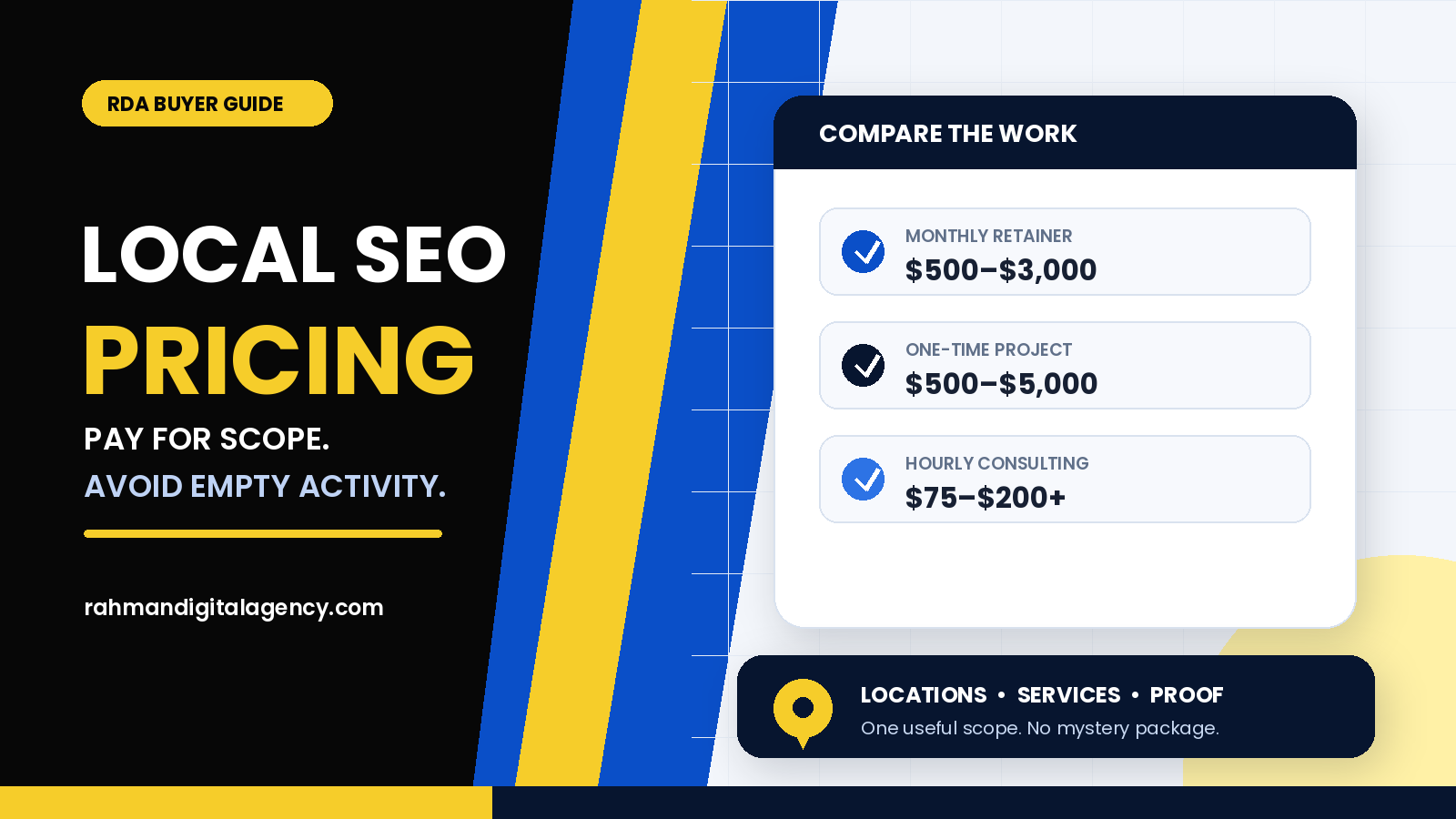
The short answer: current public industry guidance commonly places agency retainers around $500 to $3,000 per month, one-time local SEO projects around $500 to $5,000, and experienced consulting around $75 to $200+ per hour. These are broad third-party reference ranges, not a universal rate card or a Rahman Digital Agency quote.
A single-location business in a modest market may need much less work than a multi-location company competing across dense metro areas. The useful question is not “What is the cheapest package?” It is “What work is required to make each important location and service genuinely easier to find and choose?”
Local SEO helps a business improve visibility for searches connected to a geographic area—such as “dentist near me,” “roof repair in Austin,” or a branded search that opens a Google Business Profile. The work can span the profile, website, business listings, reviews, local content, technical foundations and measurement.
This guide is for US small-business owners comparing providers. It shows how to interpret pricing, identify missing scope, normalize proposals and avoid paying for activity that cannot be connected to a real location, service or customer journey.
What does local SEO cost?
Published ranges vary because “local SEO” is not a fixed bundle. WebFX reports an average of $500–$3,000 per month for retainers, $500–$5,000 for one-time projects and $75–$200+ per hour for consulting. SEO.com describes agency services generally ranging from $500–$2,000 per month, while also noting that location count, geography, scope and support affect the price.
How to use those figures: treat them as orientation, not a quote calculator. A provider should still explain the work, assumptions, deliverables and measurement behind your price. A low fee can be sensible for a narrow scope; it becomes risky when it quietly excludes essentials.
| Pricing model | Typical use | What to clarify | Main risk |
|---|---|---|---|
| Monthly retainer | Ongoing optimization, content, listings, reputation support and reporting | Monthly priorities, included locations, deliverables, approvals and cancellation terms | Paying for repetitive activity without a location-specific plan |
| One-time project | Audit, profile cleanup, location-page build, citation correction or migration support | Handover, implementation responsibility, acceptance checks and post-project support | Receiving recommendations that nobody implements |
| Hourly consulting | Specialist advice, internal-team guidance, troubleshooting or quality review | Expected hours, outputs, meeting time and documentation | Open-ended time without agreed deliverables |
| Performance-linked fee | Occasionally used with an underlying base scope | Metric definition, attribution, baseline, exclusions and data access | Incentives tied to rankings or leads the provider cannot fully control |
What changes a local SEO quote?
Number of real locations
Each eligible location may need profile management, landing pages, listings, review processes, local links and reporting. Ten locations are not simply one location copied ten times.
Market competition
A specialist in a small service area faces a different search landscape from a law firm, clinic or home-service brand competing across a major metro.
Service breadth
One core service requires a smaller information architecture than many services with different customer intent, evidence and conversion paths.
Starting condition
Duplicate profiles, inconsistent business information, thin location pages, technical defects or a history of low-quality tactics increase cleanup work.
Content and authority needs
Useful service and location content, local partnerships, digital PR and link earning demand more research and editorial effort than simple metadata edits.
Internal capacity
Pricing changes when your team supplies copy, photos, approvals, review responses and developer time rather than asking the provider to own them.
What should a local SEO package include?
A credible scope should connect each activity to a real customer decision. Not every business needs every item every month, but exclusions should be explicit.
Google Business Profile work
Category selection, services, hours, contact details, attributes, photos, posts where useful, question-and-answer monitoring and duplicate-profile review. The business should retain ownership and grant access rather than surrendering control.
Local keyword and intent mapping
The provider should map important services and locations to the right page type. A profile, service page, location page and educational article solve different search needs.
Website and technical foundations
Indexability, mobile usability, crawl paths, internal links, titles, canonicals, page speed, structured data and conversion paths should be reviewed. Our SEO audit checklist for service-business websites provides a broader technical and lead-protection review.
Service and location pages
Pages should contain useful, specific evidence for the people served in that area. Swapping a city name across near-identical pages is not a durable content strategy.
Business listings and citation consistency
Core name, address, phone and website information should be accurate on important platforms. The objective is trustworthy business data, not an impressive count of low-value directory submissions.
Review process and reputation support
The scope may include compliant review-request workflows, response guidance and issue escalation. It should never include fabricated reviews, review gating or promises to remove legitimate criticism.
Local authority building
Relevant chambers, associations, suppliers, sponsorships, community resources, partnerships and local media can create useful mentions and links. Quality and relevance matter more than bulk placement.
Measurement and business reporting
Reports should separate visibility indicators from business outcomes. Useful views can include profile actions, calls where lawfully tracked, form submissions, landing-page performance and qualified enquiries—not rankings alone.
Google explains that local results are mainly based on relevance, distance and prominence. A responsible plan therefore improves how clearly the business matches a search, represents its real locations accurately and strengthens trustworthy signals. No provider can change the searcher’s physical distance or guarantee a particular map position.
How much should your business budget?
Start with the economics of one service area rather than copying another company’s marketing percentage. Use a simple planning model:
That figure is a ceiling for the combined acquisition system—not automatically the SEO retainer. It may also need to cover website changes, call tracking, creative, paid media, software and sales follow-up.
Then match the SEO scope to four questions:
- Which locations and services matter most? Prioritize the combinations with real capacity, margin and customer value.
- What is broken or missing now? Separate cleanup work from ongoing growth work.
- What can your team reliably supply? Photos, subject expertise, approvals and review responses reduce delays only when ownership is clear.
- How will value be judged? Define qualified enquiries and sales handoff before selecting dashboard metrics.
Practical approach: a smaller business can begin with one location, a focused service set and a defined ninety-day foundation. Expansion should follow verified capacity and evidence—not a package designed for locations or services the business does not operate.
How to compare local SEO proposals
Give each shortlisted provider the same business information: locations, service areas, priority services, current website, profile access status, known problems, internal resources and desired customer actions. Then compare the replies line by line.
| Comparison item | Provider A | Provider B | Provider C | Evidence or notes |
|---|---|---|---|---|
| Locations and services included | Exact list? | |||
| Initial audit and cleanup | Findings plus implementation? | |||
| Google Business Profile scope | Ownership and access? | |||
| Service/location pages | Research, writing and approval? | |||
| Technical implementation | Who changes the site? | |||
| Listings and citations | Platforms and correction process? | |||
| Reviews and reputation | Compliant method? | |||
| Local links and mentions | Relevance and quality controls? | |||
| Measurement and reporting | Qualified-enquiry definition? | |||
| Meetings and response times | Named owner? | |||
| Contract and cancellation | Minimum term and notice? | |||
| One-time and recurring fees | Software or media extra? | |||
| Account and asset ownership | Business-controlled accounts? |
Local SEO pricing red flags
- Guaranteed map-pack or first-position rankings. Search results vary by query, location, competition and other signals.
- A package with no named locations or services. Generic activity makes accountability difficult.
- Bulk location pages with only city names changed. Near-duplicate pages can be unhelpful to users and weak as long-term assets.
- Hundreds of directory submissions sold as the main strategy. Important, accurate listings are more useful than raw volume.
- Fake reviews, review gating or ownership shortcuts. These create platform, reputation and access risk.
- Reports built only around rankings. Visibility matters, but the business ultimately needs relevant calls, forms, visits and sales conversations.
- The provider owns your profile, analytics or website account. Your business should keep control and grant revocable access.
- No implementation boundary. An audit has limited value when nobody is responsible for making and testing changes.
Questions to ask before signing
- Which exact locations and services are included?
- What will happen in the first 30, 60 and 90 days?
- Which work is one-time and which repeats monthly?
- Who writes, approves and publishes content?
- Who implements technical recommendations?
- How are duplicate or suspended profiles handled?
- How will review requests stay compliant?
- What local-link tactics are prohibited?
- Which accounts will the business own?
- How are calls, forms and qualified enquiries defined?
- What software or third-party fees are separate?
- What contract term and cancellation notice apply?
- What evidence will show work was completed?
- How will the plan change if a location lacks capacity?
Frequently asked questions
Is $500 per month enough for local SEO?
It can be enough for a tightly defined scope, especially for one location with sound foundations and modest competition. It is unlikely to fund deep technical fixes, extensive content, active authority building and multi-location support at the same time. Ask what is included and what remains your responsibility.
Why do multi-location businesses cost more?
Each real location may need distinct profile management, landing-page evidence, listings, reviews, internal links, local partnerships and reporting. Efficient systems can reduce duplication, but each location still needs accurate information and useful local relevance.
How long should a local SEO contract be?
The contract should be long enough to complete the agreed work and evaluate meaningful indicators, but it should not hide weak accountability. Review milestones, access, reporting, cancellation terms and asset ownership before signing. Ask what remains usable if the engagement ends.
Should local SEO include Google Business Profile management?
For most location-based businesses, the profile is an important part of the system. The exact monthly activity varies, but categories, services, hours, contact details, photos, reviews, duplicates and access should be addressed. The business should remain the owner.
Can a provider guarantee calls or rankings?
No provider controls every search result, competitor action, customer decision or sales outcome. A credible provider can commit to defined work, transparent methods, implementation quality and measurement. Treat guarantees of a specific ranking or lead count with caution.
When is a one-time project better than a retainer?
A one-time project can fit a clear audit, profile cleanup, citation correction, tracking setup or location-page build when your team can maintain the result. Ongoing competition, content, reviews, technical changes and multiple locations may justify continuing support.
Sources and further reading
- WebFX: Local SEO Pricing — public ranges for retainers, projects and consulting.
- SEO.com: Local SEO Pricing Guide — agency-range context and factors that change scope.
- Google Business Profile Help: Tips to improve your local ranking — relevance, distance and prominence.
- Google Search Central: Local business structured data — guidance for describing business details to search engines.
Need a scope-based SEO conversation?
Rahman Digital Agency provides SEO services for businesses that need clearer priorities, implementation and measurement. Send your website, target locations and priority services, and we can discuss the scope before an estimate is prepared.