
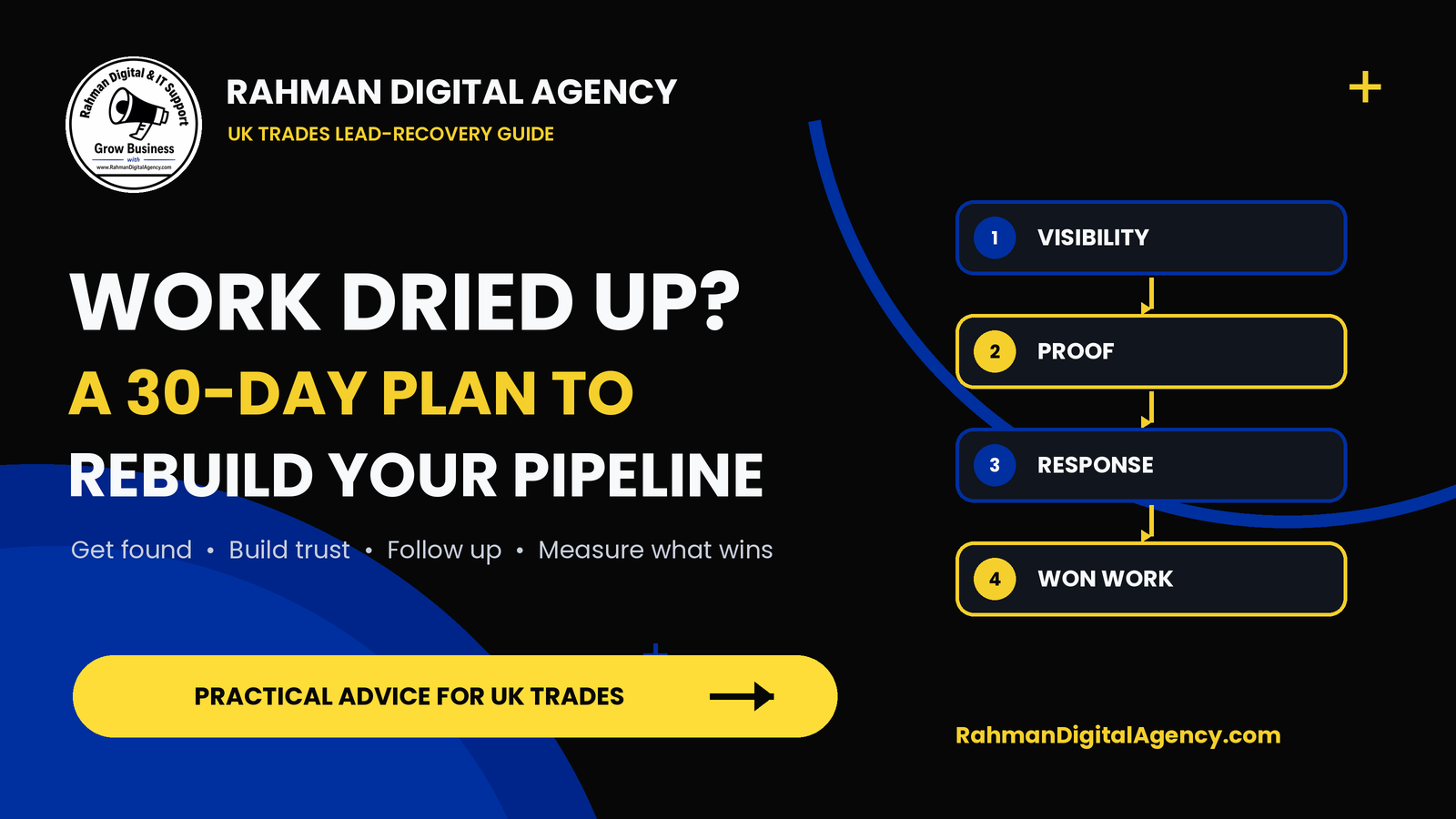
UK trades lead-recovery guide
If you have been busy for years but the phone has suddenly gone quiet, do not assume your skills are the problem. First find where your enquiry pipeline broke—visibility, trust, response, quotation or follow-up—then repair it in a measured order.
A quiet diary is frightening when your business has previously relied on recommendations and steady repeat work. The natural reaction is to cut prices, buy a list of leads or launch ads immediately. Those actions can create more pressure if you do not know which part of the pipeline is failing.
One tradesperson can be short of work while a homeowner in the same region is struggling to find someone suitable. That is a demand-matching problem: the customer may not see the business, may not understand its speciality, may not trust the available proof, or may not receive a useful response quickly enough. Effective lead generation for tradesmen therefore begins with diagnosis—not a promise that one platform will solve everything.
First, identify where the work actually dried up
Review the previous 90 days and compare them with a healthy period. Use a notebook or spreadsheet; sophisticated software is optional. Record each genuine enquiry, its source, service, postcode, approximate value, response time, whether you quoted, whether you followed up and whether it became a job.
| Signal | What it may indicate | First response |
|---|---|---|
| Very few enquiries | Visibility, referral activity or demand-source problem | Check Google visibility, past-customer referrals, local partnerships and service-area clarity |
| Enquiries arrive but are unsuitable | Message or targeting is too broad | State your speciality, locations, minimum project fit and what is not included |
| Site visits happen but few quotes are accepted | Trust, scope, price explanation or follow-up problem | Improve proof, itemise scope, explain assumptions and schedule follow-up |
| Quotes are accepted but margin is poor | Pricing, variation control or qualification problem | Qualify earlier, document exclusions and stop using discounting as the main sales tool |
The five foundations of a healthier trades pipeline
1. Clear positioning
“General building work” is difficult to evaluate. “Full kitchen installation across Leeds, including rip-out, fitting and trade coordination” helps a homeowner decide whether you fit the project.
2. Local discovery
Your website, Google Business Profile and relevant directories should agree on what you do, where you work and how a customer can contact you.
3. Visible proof
Show completed projects with location context, starting problem, scope, photographs, timescale and a genuine customer review where permission exists.
4. Fast, useful response
A reply should move the job forward: confirm the service area, ask qualifying questions and set an exact next step rather than sending “How can I help?”
5. Consistent follow-up
Many quotes are neither accepted nor rejected immediately. A polite, scheduled follow-up gives the customer a chance to ask questions without creating pressure.
6. Measured acquisition
Directories, organic search, referrals and advertising can all contribute. Keep source and outcome records so you know which channel produces profitable jobs.
Google explains that complete and accurate business information can help local visibility, while local results are mainly based on relevance, distance and prominence. Reviews, links and the information associated with the business can contribute to prominence. Read Google’s guidance on improving local ranking before paying anyone who claims they can buy a guaranteed local position.
A practical 30-day lead recovery plan
Days 1–3: build the pipeline baseline
List every enquiry from the last 90 days. Calculate enquiry-to-visit, visit-to-quote and quote-to-win rates. Note average response time and the source of each won job. If the records are incomplete, begin tracking from today rather than inventing numbers.
Days 4–7: reactivate trust you have already earned
Contact suitable past customers individually where it is appropriate and lawful. Ask whether the completed work is still performing well, invite an honest review and make it easy to recommend you to someone who needs the same service. Do not upload old customer details into bulk marketing tools without checking consent and the rules that apply. The ICO’s electronic-mail marketing guidance explains the UK requirements.
Week 2: repair local visibility
Check your business name, phone, service areas, opening information, primary category, services, photographs and website link. Add recent project photographs regularly, but avoid stock images presented as your work. Create or improve a dedicated website page for each genuinely distinct high-value service instead of copying the same page for many towns.
Google allows businesses to request reviews with a link or QR code but prohibits incentives such as discounts in exchange for reviews. Follow its review guidance and respond professionally to positive and negative feedback.
Week 3: turn completed work into decision-making proof
Publish three useful project stories. Each should state the type of property, location area, customer problem, agreed scope, complications discovered, how they were handled, approximate timescale and final result. Remove personal details and obtain permission for identifiable photographs or quotations.
Week 4: test one controlled acquisition channel
Choose one channel that matches the service and location: a supplier partnership, a carefully selected lead platform, local organic search or a tightly targeted advertising test. Define the budget, qualification criteria, landing page, response owner and success measure before starting. Record qualified leads and won revenue, not only clicks.
Example: a kitchen or bathroom specialist
Turn a broad service into a qualified enquiry path
A kitchen and bathroom business should not send every visitor to a generic homepage. Build separate, substantial service pages when the projects and customer decisions differ. A kitchen-installation page might explain rip-out, cabinetry fitting, worktop coordination, plumbing/electrical coordination, finishing, typical timescale factors and service areas. A bathroom page should address waterproofing, ventilation, tiling, sanitaryware, access and the boundary between supply-only, fit-only and full installation.
Use a short enquiry form that asks for postcode, room type, desired start period, whether materials are chosen, approximate budget band and permission to upload photographs. These questions reduce wasted calls while giving serious homeowners a clearer first step.
What to publish as proof
- Before-and-after photographs from the same viewing angle.
- A short explanation of the original problem and agreed result.
- The main scope, including what your team did and what another trade supplied.
- Location at town or district level without exposing a customer’s address.
- Timescale factors and any variation handled during the work.
- An authentic review linked to the relevant type of project.
When the website is built around these decisions, it becomes more than an online brochure. RDA’s guide to a lead generation website for a service business explains how service pages, proof, qualification and measurement should work together.
When should a trades business use paid advertising?
Advertising can accelerate an offer that already has a clear service, convincing proof, a suitable landing page and disciplined response. It cannot repair unclear positioning or poor follow-up. Before spending, confirm the locations you can profitably serve, the job types you want, what counts as a qualified lead and how calls and forms will be recorded.
Kitchen and bathroom businesses should separate high-intent installation searches from research, jobs, training, DIY and product-only searches. Send traffic to the matching service page—not automatically to the homepage. RDA’s detailed guide to PPC for bathroom designers covers campaign structure, lead quality and project-focused landing pages.
Budget only after the basic journey is sound. Our small-business digital marketing budget guide shows how to separate foundations, acquisition and measurement instead of spending everything on traffic.
Measure whether the plan creates real work
Review the numbers weekly. Track enquiries by source, qualified leads, appointments or site visits, quotes, wins, expected revenue, actual revenue and gross margin. On the website, a form button click is not the same as a completed enquiry. Google Analytics recommends the generate_lead event when a lead is actually generated; the event should fire only after the business has confirmed a successful submission. See Google’s recommended-event reference.
| Metric | Why it matters | Weekly question |
|---|---|---|
| Qualified enquiries | Shows whether visibility reaches suitable customers | Did the person, job and location fit? |
| Median response time | Slow contact can lose an otherwise good opportunity | How quickly did we provide a useful next step? |
| Quote rate and win rate | Separates enquiry quality from the sales process | Where are suitable projects dropping out? |
| Cost per qualified lead | Prevents cheap but irrelevant leads from looking successful | What did each real opportunity cost? |
| Won margin by source | Connects marketing with sustainable work | Which source produced profitable jobs? |
Frequently asked questions
What is the fastest way for a tradesperson to get more leads?
The fastest responsible starting point is usually to contact genuine past relationships appropriately, request honest reviews, improve quote follow-up and make current availability clear to local partners. These actions can work sooner than waiting for search visibility, but they still require permission, professionalism and accurate service information.
Should I use a trades lead platform?
It can be useful if the job types, geography, fees, competition and refund rules fit your business. Test with a fixed limit. Record every lead, whether it was contactable and suitable, and the margin from won jobs. Do not judge the platform only by the number of notifications.
Do I need a separate website page for every town?
No. Create location pages only where you genuinely serve the area and can provide distinct, useful information. Repeating the same page with a different town name does not help a homeowner make a decision. Strong service pages, project examples and accurate service-area information are a better foundation.
Should I lower my prices when work is quiet?
Not automatically. First check whether enough suitable people are finding you, whether your quote explains scope and value, and whether follow-up happens. Discounting cannot solve invisibility and may create margin problems. If you change pricing or packaging, document the reason and measure the result.
How long does local marketing take?
Past-customer referrals and better follow-up can create opportunities quickly. Website and local-search improvements usually need consistent work and do not guarantee a fixed timetable. Paid campaigns can generate traffic sooner, but only become useful when targeting, qualification, response and tracking are ready.
Useful references
Need a measurable lead-recovery plan?
Rahman Digital Agency can review your local visibility, service pages, project proof, enquiry journey, follow-up and advertising readiness—then prioritise the changes most likely to produce qualified opportunities.