
Posted on

AI Automation Proposal Checklist for UK Small Businesses: Scope, Controls and Handover

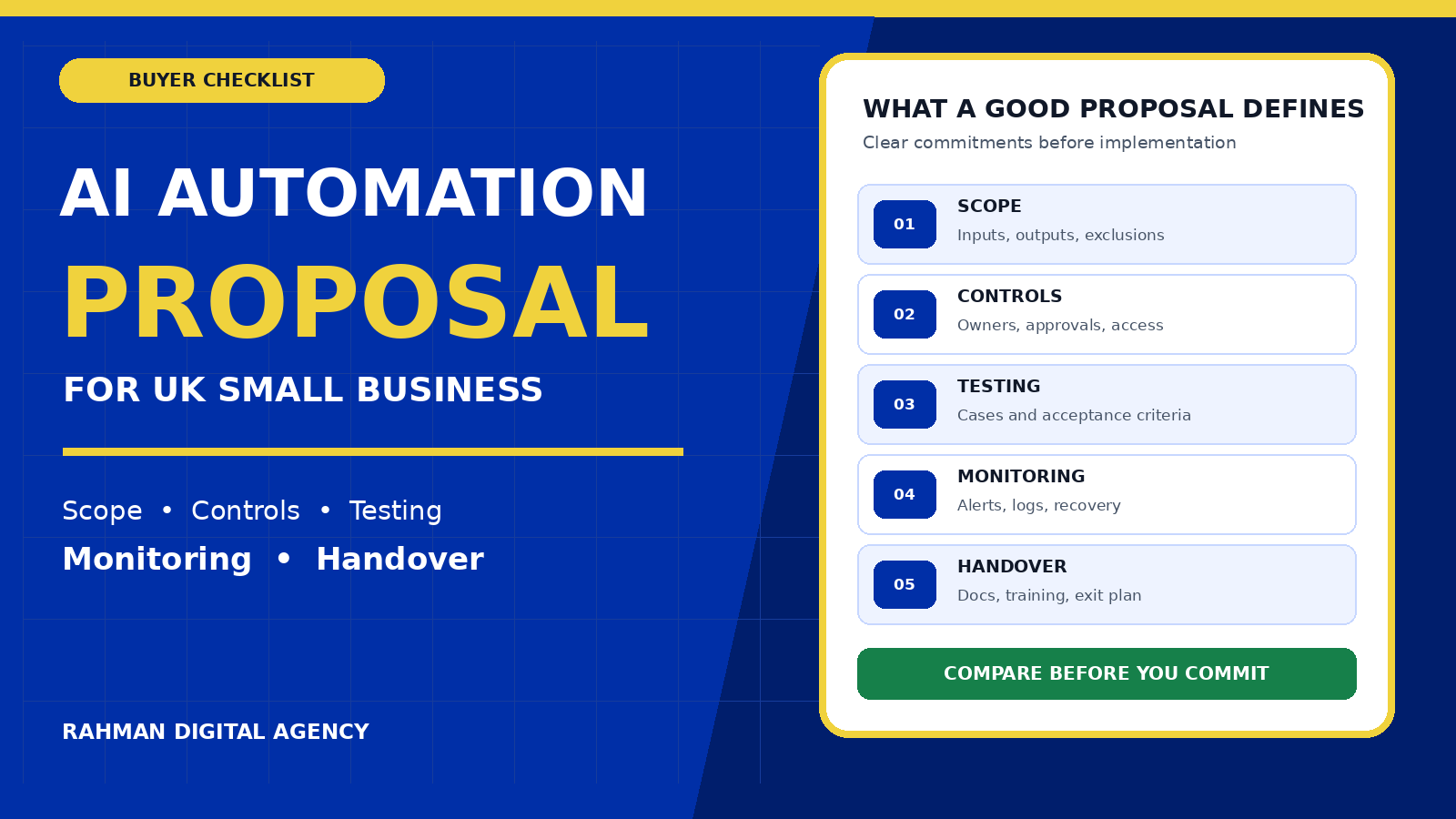
AI automation proposal checklist covering scope, controls, testing, monitoring and handover for UK small businesses

Buyer checklist

A useful AI automation proposal should make the future workflow understandable before anyone builds it. It should define what happens, what does not happen, who remains responsible, how success will be tested, and how your team can operate or exit the system later.

That standard matters because an attractive demonstration is not the same as a dependable business process. A proposal can mention AI, integrations and dashboards yet leave the buyer to discover hidden usage costs, weak exception handling or unclear data responsibilities after implementation.

This checklist is for UK small-business owners and operations leaders comparing an agency, consultant or software-led automation proposal. It is practical procurement guidance, not legal advice. If the planned workflow makes significant decisions about people, handles sensitive data or supports a regulated activity, seek appropriate legal and specialist review.

AI automation proposal checklist: the short version

Before approving work, confirm that the written proposal covers all ten items:

  • A named business outcome with a measurable starting point and target.
  • A defined workflow boundary, including triggers, outputs, exceptions and exclusions.
  • A system and data map showing what is accessed, transferred, stored and deleted.
  • Human decision points, approval rights and an accountable process owner.
  • Test cases and acceptance criteria agreed before launch.
  • Security and access controls appropriate to the data and systems involved.
  • Monitoring, alerts and recovery for failed or unexpected runs.
  • Costs and change rules covering setup, tools, usage, support and revisions.
  • Documentation and handover that your team can actually use.
  • Ownership and exit terms for accounts, assets, data and supplier changes.
1

Start with the business outcome, not the technology

The proposal should name one operational result in plain language. “Implement an AI agent” is a technical activity. “Reduce manual enquiry triage and response delay by classifying new enquiries, sending complete records to the correct sales queue within two minutes, and holding ambiguous cases for review” links the workflow to an operational outcome.

Ask the supplier to document the current baseline: monthly volume, average handling time, rework, response delay, error rate or another relevant measure. Then agree the target and the observation period. A sensible target can be “reduce median processing time while keeping routing accuracy above the agreed threshold”; it should not be an unqualified promise of revenue or perfect accuracy.

Ask for: current state, intended future state, baseline, target metric, measurement method, process owner and review date.

If you are still deciding whether a workflow is suitable, complete an AI automation readiness audit before comparing build proposals.

2

Define the workflow boundary and exclusions

A decision-ready proposal follows the work from start to finish. It names the trigger, required inputs, processing steps, outputs, destinations and people involved. It also states what is outside scope.

For an enquiry-routing workflow, the boundary might begin when a website form is submitted and end when a validated record is created in the CRM and the correct team is notified. It should explain what happens when a required field is blank, a duplicate arrives, the CRM is unavailable, the message is spam, or the model is uncertain. If a score is used to decide which cases receive human review, the proposal should explain how that score is produced and validated against representative cases rather than assuming it is a dependable probability.

Weak scope: “Automate lead management with AI.”
Decision-ready scope: “Validate six required form fields, identify the requested service from an approved taxonomy, apply a tested review rule, route cases that pass that rule, hold the remainder for a named reviewer, and log every outcome.”

List languages, channels, business units and historical data separately. If something is excluded—such as telephone enquiries, document interpretation or automatic quote approval—put the exclusion in the proposal rather than relying on a sales conversation.

3

Map systems, data and supplier access

The proposal should identify every connected system and the minimum access each connection needs. This can include forms, email, CRM, cloud storage, messaging tools, accounting software, analytics platforms and model providers.

For each data type, ask where it comes from, why it is needed, where it is processed, how long it is retained and how it is removed. The ICO’s guidance on AI and data protection addresses accountability, transparency, lawfulness, fairness, security, data minimisation and individual rights. Those topics should be reflected in the design when personal data is involved.

Do not accept “GDPR compliant” as a substitute for a data map. The proposal should distinguish your responsibilities from the supplier’s, identify relevant third parties, and state whether your information may be used to train or improve an external model. Your legal adviser can determine the agreements and assessments required for the specific use.

Access rule: prefer named business-owned accounts, least-privilege permissions, separate development and production credentials, multi-factor authentication where available, and a documented method for revoking access.
4

Keep meaningful human control

“Human in the loop” is only useful when the proposal defines the loop. It should name who reviews an item, what evidence they receive, how quickly they must respond, what authority they have to override the system, and what happens when they are unavailable.

Human review is particularly important when an output could materially affect a customer, employee or supplier. The person should not be a ceremonial approver. They need enough context, time and authority to question the output and choose a different action.

Write down actions the automation may take independently and those that always require approval. Sending an internal notification may be low risk. Rejecting an applicant, issuing a binding quote, changing payment details or sending sensitive information may demand stronger controls or may be unsuitable for autonomous execution.

5

Agree test cases and acceptance criteria before launch

“Tested and working” is not an acceptance criterion. A proposal should describe representative tests, expected results and the evidence you will receive.

  • Normal cases: common, complete and valid inputs.
  • Boundary cases: maximum lengths, unusual formats, multilingual text or borderline classifications.
  • Failure cases: missing values, invalid records, rate limits, expired credentials and unavailable systems.
  • Safety cases: prompt injection attempts, untrusted attachments, inappropriate requests and confidential information.
  • Recovery cases: retry behaviour, duplicate prevention, manual replay and reconciliation after an outage.

Test input and record quality separately from model and end-to-end workflow performance. The UK Government’s Data Quality Framework distinguishes completeness, uniqueness, consistency, timeliness, validity and accuracy for data. Choose the data dimensions that matter to the workflow and define pass criteria for each. Then add task-specific measures—such as routing precision, false-positive and false-negative rates, abstention or review rate, and successful completion—where they are relevant.

Important: test with authorised, representative data and include cases where the correct action is to stop and request human help. A system that always returns an answer can be less dependable than one that knows when not to proceed.
6

Specify security, monitoring and recovery

An automated workflow becomes part of business operations, so the proposal should cover both prevention and recovery. Ask how credentials are stored, permissions are restricted, changes are reviewed, dependencies are updated, records are logged and unusual behaviour is detected.

The UK Government’s Code of Practice for the Cyber Security of AI includes supply-chain security, documentation of data, models and prompts, appropriate testing, regular updates, behavioural monitoring and proper disposal. A small business may implement controls proportionately, but the proposal should not ignore them.

Monitoring should state who receives an alert, what information the alert contains, when a retry is safe and when the system stops. Recovery should cover backups or reprocessing where relevant, a manual fallback, duplicate prevention, and a record of actions already taken.

Minimum operating evidence: timestamp, workflow version, input reference, decision or route, external-system response, final state and an error category that supports action—without placing unnecessary personal or confidential data in logs.
7

Make costs and change control explicit

Separate one-off implementation from recurring costs. The proposal should identify supplier support, automation platform charges, model or API usage, database or storage costs, communication fees and paid connectors. For usage-based services, request the unit, forecast assumptions, alert threshold and spending limit.

Also define what counts as a correction, an in-scope refinement and a new requirement. A changed CRM field, an additional language and a new approval path can have very different effects. A simple written change process prevents every adjustment becoming either a surprise invoice or an undocumented production edit.

AreaVague wordingDecision-ready commitment
OutcomeImprove efficiencyName the process, baseline, target, measurement and review date
ScopeConnect our systemsList systems, fields, permissions, steps, exceptions and exclusions
TestingFull QA includedProvide test categories, expected results, pass thresholds and sign-off owner
SupportOngoing supportState coverage, response targets, monitoring owner and excluded work
CostFrom £X per monthSeparate setup, subscription, usage, support and change charges
ExitCancel at any timeExplain account ownership, export format, credential removal and transition help
8

Require documentation, handover and an exit plan

Documentation is part of the product, not an optional extra. A good handover explains the workflow in business language and provides enough technical detail for safe operation.

  • A current workflow diagram and plain-English operating description.
  • A list of systems, accounts, permissions, owners and third-party dependencies.
  • Configuration, field mapping and approved prompts or rules, with sensitive values excluded.
  • A runbook for alerts, failures, manual fallback and common changes.
  • Test results, known limitations and outstanding risks.
  • Training for the people who operate, review and approve the workflow.
  • A version history and method for approving future changes.

The exit section should say who owns the workflow, documentation, domain-specific configuration, accounts and data. It should explain how information will be exported, how supplier access will be removed, and what happens to retained copies. Business-owned accounts and portable documentation reduce avoidable lock-in.

A simple 20-point proposal scorecard

Score each of the ten checklist areas at the top of this guide:

  • 0: absent or only discussed verbally
  • 1: mentioned but not specific enough to verify
  • 2: specific, verifiable and assigned to responsible parties where applicable

A total does not replace judgement: one critical zero in security, human control or data handling can outweigh a strong overall score. Use the scorecard to expose questions, compare like with like and record why you accepted a trade-off.

Worked example: lead qualification and routing

Imagine a UK service business that wants to route website enquiries. A responsible first phase might validate form fields, remove obvious spam, classify the requested service from an approved list, and send uncertain cases to a sales coordinator. If the design uses a model score to separate cases, the supplier should validate the score and threshold against representative data; tested ambiguity rules and human review should remain available when a score is not reliable enough.

Acceptance criteria could include:

  • every valid submission produces one traceable CRM record;
  • a retry does not create a duplicate record;
  • cases that meet the tested review rule are held for a named person;
  • repeated CRM failures alert the responsible owner; and
  • a manual submission route remains available.

The supplier should test normal, incomplete, duplicate, adversarial and outage scenarios.

This makes the proposal more useful than a generic promise to “qualify leads with AI.” It also provides a controlled path from pilot to wider use. For a detailed implementation pattern, see our guide to automating lead qualification and routing.

Red flags when comparing proposals

  • The demonstration is polished, but there is no written process map or exception list.
  • The proposal guarantees perfect accuracy, revenue or hours saved without a baseline and measurement method.
  • One shared administrator login is requested for every connected system.
  • “Human review” appears in the sales deck but has no named role, queue or response process.
  • Testing excludes failures, retries, duplicates, unsafe inputs or third-party outages.
  • Recurring model, platform, messaging or support charges are omitted.
  • Your supplier owns production accounts that your business cannot access.
  • Documentation and transition assistance are unavailable or priced only after cancellation.
  • The system processes more personal data than the stated outcome requires.
  • There is no safe manual fallback for a workflow the business depends on.

Questions to ask before signing

What evidence will show that the automation is ready to launch?

Ask for named test cases, expected results, pass thresholds, known limitations and a sign-off process. Confirm who can delay launch if evidence is incomplete.

Who owns the accounts and automation assets?

Prefer business-owned production accounts with supplier access granted through named users or roles. The proposal should distinguish reusable supplier intellectual property from your data, configuration, workflow assets and documentation.

What happens when a connected service fails?

Look for bounded retries, duplicate protection, alerts, a manual fallback and a reconciliation procedure. “The platform retries automatically” does not explain who verifies the final business outcome.

How will changes be tested after launch?

Require version control or a change history, a safe test environment where practical, regression tests for critical paths, approval before production deployment and a rollback method.

How should a small business use AI risk frameworks?

Use them proportionately to improve questions and controls, not as a claim that every item applies identically. The NIST AI Risk Management Framework is voluntary and designed for different sectors and organisation sizes. Its companion Playbook organises suggested actions around Govern, Map, Measure and Manage; NIST explicitly notes that the suggestions are not a universal checklist to follow in full.

What a strong proposal lets you decide

A strong proposal does not remove uncertainty. It makes the important uncertainty visible and gives you a controlled way to learn. You should be able to tell what will be built, how it will behave, which risks remain, what your team must do, what it will cost, and how to stop or change course.

That is the difference between buying a promising demonstration and commissioning an operating capability. If you want to understand practical use cases first, read our guide to AI automation for small business.

Useful official resources

Need an automation proposal you can evaluate?

Rahman Digital Agency can help you define and implement an AI-enabled workflow with explicit scope, review points, testing, monitoring and handover. Start with one qualified use case and a documented path from pilot to dependable operation.

Explore AI automation services Discuss your workflow
Posted on

Google Ads Management Agency UK: 12 Questions Before You Hire

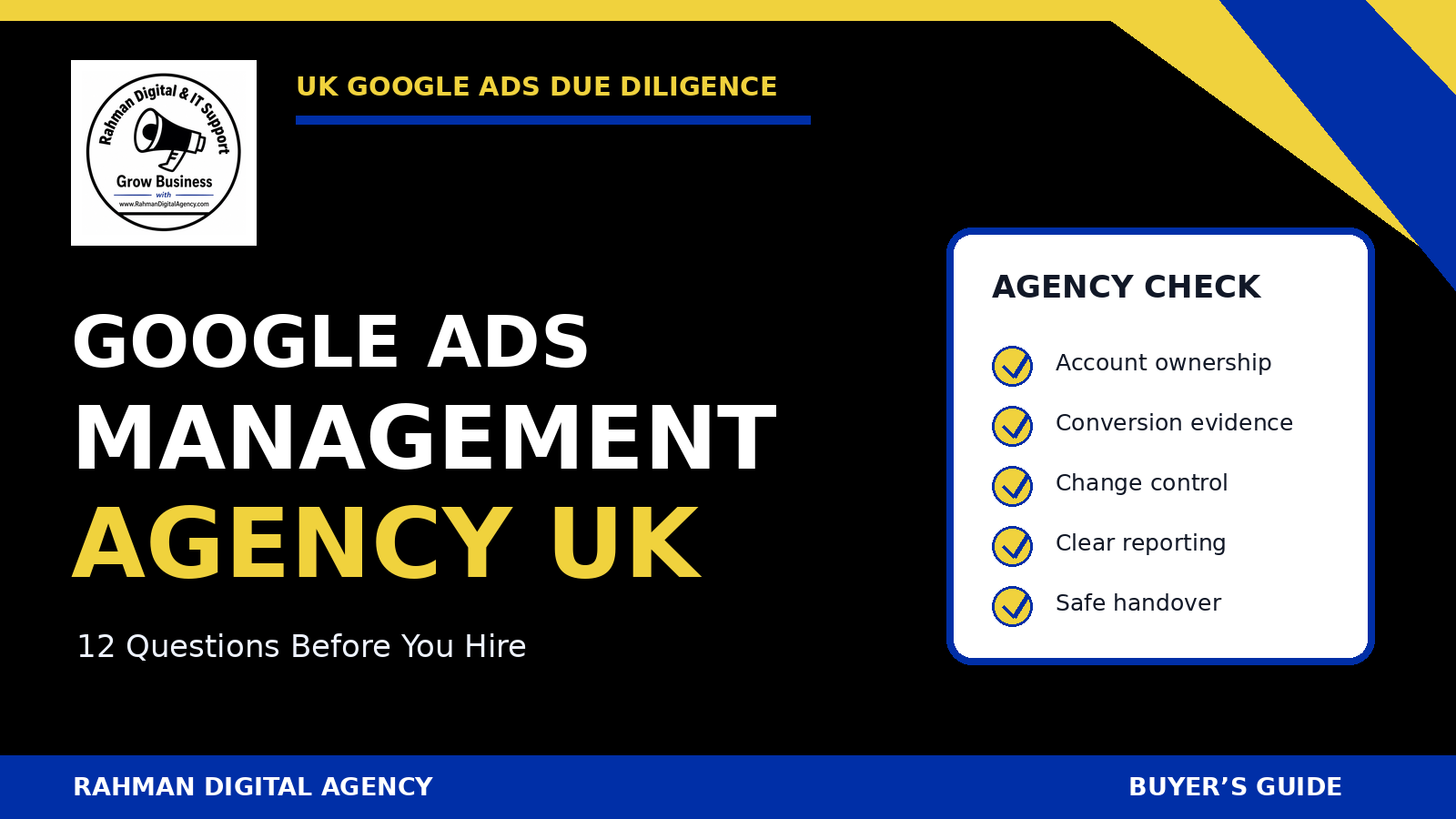
Google Ads management agency UK buyer checklist by Rahman Digital Agency

A buyer’s due-diligence guide for UK advertisers

People searching “Google Ads management agency UK” need more than a provider list. A credible agency should be able to explain account ownership, commercial goals, conversion evidence, decision-making and handover in plain language. This guide gives you twelve questions that reveal how an agency will actually operate after the pitch.

Updated: 16 September 2026By Rahman Digital AgencyReviewed against current Google and UK guidance

The short answer

Choose a Google Ads agency by inspecting control, evidence and process—not promises. Your business should own the Ads account and critical data assets, approve meaningful commercial changes, know which actions count as conversions, receive reporting tied to qualified outcomes, and have a documented exit path. Credentials can support due diligence, but they do not replace a strategy that fits your economics.

Searching for a UK Google Ads management partner is not the same as buying a standard product. Two agencies can use the same platform while making very different choices about measurement, campaign structure, search terms, creative, landing pages and communication. The buyer therefore needs a repeatable way to test whether the working relationship will be accountable.

Before comparing agencies, define the job

A weak brief asks an agency to “improve the account.” A useful brief states what the business sells, where it can serve customers, which outcomes matter, how long the sales cycle is, what cannot change without approval and which systems hold the truth.

Prepare these facts before the first call:

  • Products or services that are commercially important, available and adequately supported.
  • Geographic coverage, capacity limits and any regulated or restricted categories.
  • Typical path from enquiry to qualified opportunity, sale or completed job.
  • Known gross-margin or allowable acquisition-cost constraints, using your own verified numbers.
  • Current Ads, Analytics, Tag Manager, website, CRM and consent-management ownership.
  • Decision makers, approval limits and the reporting rhythm your team can sustain.

If the current account is difficult to interpret, start with an evidence-led review. RDA’s Google Ads account audit guide explains the areas an audit should cover without pretending that a checklist alone is a strategy.

Twelve questions to ask a Google Ads management agency

1. Who will own the Ads account and billing relationship?

The safest default is that the advertiser retains administrative control of the account and adds the agency with an appropriate access level or through a manager-account link. Google documents several access levels and allows client accounts to be linked to manager accounts. Ask who can invite users, change payment details, unlink management and recover access.

Do not accept “we always build campaigns in our account” without understanding the consequences. If the relationship ends, the business should know what happens to campaign history, audiences, tags, creative, exclusions and billing records.

2. What business outcome will guide optimisation?

“More conversions” is incomplete. A form completion, phone-number tap, qualified call, booked appointment and completed sale are different events. Ask the agency to map the conversion ladder and identify which outcomes are primary bidding signals, secondary observations and offline feedback.

A responsible answer includes limitations. The agency should not claim that every tracked lead is qualified or that revenue attribution is exact. Where the data supports it, later-stage outcomes can be imported to provide stronger feedback than a page-view or button click.

3. How will you verify conversion tracking before changing bids?

Google Ads can measure website actions, calls and imported outcomes, but implementation quality varies. Ask for a test plan: trigger conditions, duplicate prevention, consent behaviour, currency and value handling, cross-domain journeys, form success states, call attribution and comparison with CRM records.

RDA’s guide to GA4 and GTM conversion tracking covers the measurement foundation. The agency should be able to distinguish a technical tag firing from a commercially valid conversion.

4. How will you learn which search terms produce qualified demand?

Keywords are targeting instructions; search terms are the queries that resulted in ads being shown. Google’s search terms report provides important evidence, although privacy thresholds mean it does not disclose every query. Ask how frequently the team reviews terms, records exclusions and relates query themes to actual lead quality.

Negative keywords can reduce irrelevant exposure, but careless lists can also block valuable searches. Ask for examples of the reasoning process, not a promise to add hundreds of negatives. RDA’s negative-keyword guide explains why match types and close variants need deliberate review.

5. What will you change first, and what evidence supports that priority?

A credible first-month plan is specific but conditional. It may prioritise tracking repairs, search-term waste, geographic leakage, campaign segmentation, ad-to-page mismatch or budget allocation. The agency should explain why one problem comes before another and what it will leave unchanged until more evidence exists.

Google Ads change history can show account changes over time. Ask how actions, hypotheses and expected effects will be documented so that later performance discussions do not rely on memory.

6. How do you decide between automation and manual controls?

Automated bidding can use auction-time signals, but it still depends on goal selection, conversion quality, budget, data volume and constraints. Manual control is not automatically superior either. Ask what conditions must be true before a bidding change, how learning periods will be protected and how the agency will respond when imported outcomes are delayed.

The answer should reflect your account rather than a universal favourite. RDA’s lead-generation bidding strategy guide gives context for the trade-offs.

7. How will landing pages be evaluated?

An agency that controls media but ignores the post-click journey may keep paying for a broken experience. Ask how it will assess message continuity, mobile usability, speed, trust, form friction, phone journeys and the difference between a page conversion and a qualified enquiry.

Google’s recommendations and Quality Score diagnostics can highlight opportunities, but platform scores are not business outcomes. A useful agency tests substantive hypotheses and explains the measurement window. See RDA’s practical guide to improving Google Ads landing-page conversion rate.

8. How will experiments be designed and read?

Google Ads supports campaign experiments for testing certain changes. Ask what qualifies as a test, which variable will change, what success metric applies, how long the observation should run and what would invalidate the conclusion. A small account may not generate enough data for a clean platform experiment; the agency should say so rather than manufacture certainty.

A good answer also protects the business from endless testing. Not every obvious tracking defect or misleading claim needs an experiment before correction.

9. Which competitive signals will you use—and which will you ignore?

Auction Insights can show metrics involving other advertisers in the same auctions. It does not reveal their profitability, budgets, conversion quality or full strategy. Ask how competitor observations will inform decisions without turning the account into a copy of visible rivals.

The agency should be equally cautious with third-party estimates. Use them as directional research, then make decisions from your account, website, CRM and operational feedback.

10. What approvals, safeguards and policy checks are built into delivery?

Ask who can launch campaigns, change budgets, add networks, alter geographic reach, modify conversion goals, publish claims or change landing pages. Set thresholds for material actions. The agency should also review Google Ads policies relevant to the offer and avoid misleading identity, unsupported results or hidden commercial terms.

For UK users, cookie and similar-technology practices may engage PECR and data-protection requirements. The ICO publishes current guidance, but the right implementation depends on the facts. An agency can identify tracking implications; qualified legal or privacy advisers should decide legal obligations.

11. What will the report show beyond platform totals?

Ask for a sample report with commentary. It should connect spend and platform activity to qualified outcomes where the evidence allows, disclose data limitations, and show what changed. A table of clicks, impressions and conversions without lead-quality context is not enough for a service business.

The report should also separate observation from interpretation. “Cost per reported form completion fell” is an observation. “Lead quality improved” needs CRM or sales evidence.

12. What happens if we stop working together?

A professional offboarding process is not disloyal; it is operational hygiene. Ask about notice, final billing, account unlinking, access removal, file delivery, change notes, dashboards, scripts, creative assets, audience ownership, tag documentation and the final reporting period.

Confirm the process in the agreement before work starts. The business should not discover during a dispute that critical assets or history sit in an inaccessible account.

How to assess the answers

AreaStrong evidenceWeak signalFollow-up
OwnershipNamed owner, least-privilege access and written offboarding“We handle everything”Show the proposed access model.
MeasurementConversion map, test cases, CRM reconciliation and limitationsScreenshots of total conversionsWhich event will bidding optimise towards?
StrategyPriorities tied to business economics and observed account issuesA fixed tactic for every accountWhat evidence would change the plan?
ReportingQualified-outcome context, changes, caveats and next decisionsAutomated metric dumpHow are rejected leads represented?
ClaimsCareful scope and explicit uncertaintyGuaranteed leads, ROAS or top placementWhich assumptions underpin the forecast?

Simple shortlisting method: score each provider from 0 to 2 on ownership, measurement, commercial understanding, change control, reporting and offboarding.

Use the score to expose missing evidence, not to automate the buying decision. References, communication fit, sector constraints and the actual people assigned to the account still matter.

Agency, freelancer or in-house?

Agency

Can combine media, tracking, creative and landing-page skills. Check who does the day-to-day work, how knowledge is handed between specialists and whether senior expertise appears after the sales call.

Freelancer

Can offer direct communication and specialist depth. Check capacity, cover during absence, documentation, data protection and how dependent the account becomes on one person.

In-house

Can sit close to sales and operations. Check whether the role has enough time, platform depth, measurement support and challenge from outside the organisation.

Hybrid

An internal owner can set priorities and provide lead-quality feedback while an external specialist executes and audits. Define decision rights to prevent duplicated or conflicting changes.

The right model depends on account complexity, internal capability, change volume and commercial risk. A small specialist account may value direct senior attention more than a large service menu. A multi-market advertiser may need broader governance and coverage. Do not infer quality from headcount alone.

A safe onboarding checklist

  1. Inventory ownership: record the owner and administrator for Ads, Analytics, Tag Manager, Merchant Center where relevant, website, domain, CRM, consent platform and call-tracking tools.
  2. Back up the baseline: export current settings, conversion actions, budgets, campaign status, change history and key reports before material changes.
  3. Use named access: avoid shared credentials; assign the least privilege needed and record who approved access.
  4. Agree the conversion specification: define events, values, deduplication, qualification stages and sources of truth.
  5. Set change authority: document what the agency may change routinely and what requires written approval.
  6. Protect billing: understand who can edit payment information, promotional credits and spend limits.
  7. Create a measurement QA plan: test consent states, devices, forms, calls, CRM handoff and reporting before trusting automation.
  8. Schedule feedback: ensure sales or operations can return lead-quality information at a useful cadence.
  9. Define incident handling: set escalation routes for disapprovals, tracking failures, unexpected spend or site outages.
  10. Document offboarding now: specify deliverables and access removal before the first campaign change.

What a useful monthly review should include

The exact report should match the business, but the decision structure is broadly reusable:

  • Spend and delivery by commercially meaningful segment, with comparison periods stated.
  • Primary and secondary conversion actions, plus tracking changes that affect comparability.
  • Qualified, rejected, booked or sold outcomes where CRM evidence is available.
  • Search-term, location, device and landing-page observations with privacy thresholds acknowledged.
  • Material account changes, why they were made and when their effects can reasonably be assessed.
  • Budget constraints, capacity issues and external factors that limit interpretation.
  • Next actions, owner, approval requirement and the evidence each action is expected to improve.

Google’s optimization score and recommendations can surface ideas, but they should not become the report’s objective. Recommendations require review against margin, lead quality, policy, geography and operational capacity.

Red flags—and caveats that are actually responsible

Red flags

  • Guaranteed leads, profit, return on ad spend, first position or a fixed cost per acquisition without defensible conditions.
  • Refusal to identify the actual account manager or explain account ownership.
  • Optimising before conversion actions have been tested.
  • Reports that hide spend, change history, conversion definitions or rejected-lead feedback.
  • Pressure to launch unsupported claims, imitate competitors or bypass consent and policy review.
  • No written exit process or a plan that depends on assets the advertiser cannot access.

Fair caveats

Some caution is a sign of competence. An agency may reasonably say that a forecast is conditional, an account needs a diagnostic period, a low-volume experiment will be inconclusive, lead quality depends on sales feedback, or a privacy question needs legal advice. That is more useful than confident fiction.

Google Partner status is not a substitute for due diligence. Google publishes programme requirements, but any claimed badge should be verified and the buyer should still assess ownership, strategy, measurement, assigned staff and commercial fit.

Frequently asked questions

Should my business own the Google Ads account?

Usually, yes. The advertiser should retain administrative control and grant appropriate access to the agency. Confirm billing, linked products, recovery options and offboarding in writing.

How much should Google Ads management cost in the UK?

There is no universal responsible fee. Scope can vary by spend, campaign count, markets, creative, tracking, landing pages, reporting and meeting requirements. Compare the included work, approval model and commercial evidence—not only the fee format.

Is a Google Partner automatically the best agency?

No. Programme status can be one verifiable signal, but it does not prove fit for your sector, account size, measurement needs or team. Verify any claim and continue the full due-diligence process.

Should an agency guarantee a return?

No provider controls auctions, competitor decisions, website performance, market demand, pricing, sales follow-up or customer quality. Responsible agencies can model scenarios and define assumptions, but they should not present a forecast as a guarantee.

How soon should performance be judged?

There is no universal duration. First confirm that tracking and qualification are valid. Then consider spend, conversion volume, sales cycle, material changes and data delays before drawing conclusions.

What access should an agency receive?

Only the access needed for its agreed duties. Use named users or a manager-account link, keep an internal administrator, review access regularly and remove access promptly during offboarding.

Need an evidence-led review of your UK Google Ads account?

Rahman Digital Agency can review campaign structure, search terms, conversion tracking, landing journeys and reporting, then explain the priorities and limitations clearly. We do not promise rankings, lead volume or business results.

Review RDA’s UK Google Ads management service Discuss your account with RDA

Sources and further reading

This article provides general advertising, measurement and procurement information, not legal advice. Google Ads features, programme rules, policies and interfaces change. Review current primary sources and obtain qualified legal, privacy, tax or contractual advice for your circumstances.