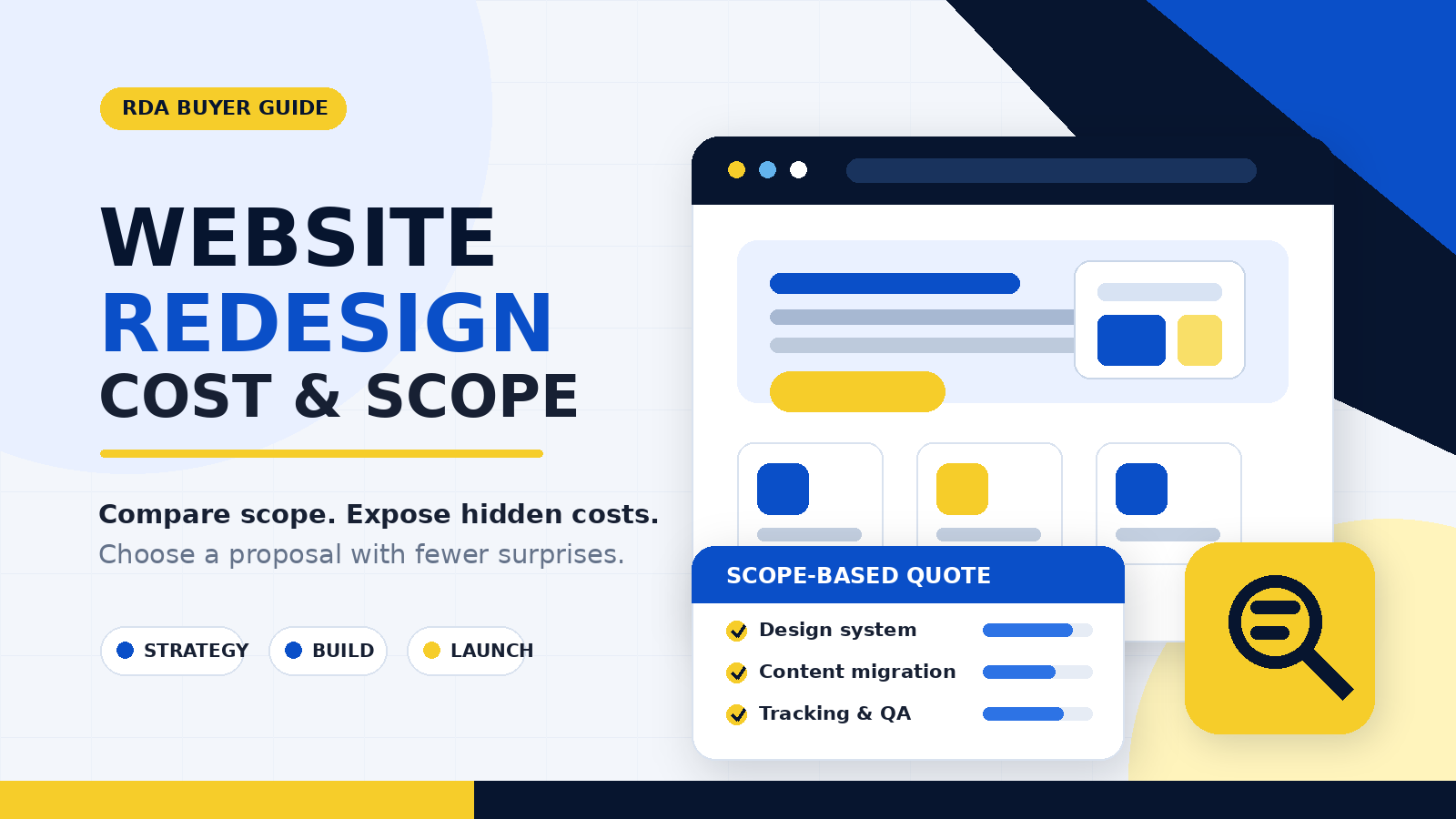
US website redesign buyer guide
A useful redesign budget starts with scope, not a headline price. Compare what each quote includes, expose recurring and migration costs, and define what must work before you approve a launch.
The short answer: current public pricing guidance is broad. WebFX reports an average website redesign cost of $3,000 to $75,000. That range is directional third-party context—not a Rahman Digital Agency price list, a universal benchmark or a quote for your business.
The number becomes useful only after you define whether you need a visual refresh, a strategic conversion redesign or a platform rebuild. Normalize every proposal around the same templates, content, integrations, migration work, testing and first-year operating costs.
A website redesign can mean changing colors on five templates, rebuilding a lead-generation journey, moving hundreds of URLs to a new CMS, or replacing ecommerce and CRM connections. Those projects should not cost the same. A page count alone does not show the work because fifty pages built from five repeatable templates differ from fifty custom layouts.
This guide is for US small-business owners and marketing leaders comparing providers. It complements our website design brief checklist: the checklist helps you prepare project inputs, while this guide helps you judge the price and risk behind competing redesign proposals.
What should a website redesign cost?
The honest answer is that cost should reflect the amount of discovery, UX and visual design, development, copy, content migration, integration and quality assurance required. The same dollar figure can represent good value for one scope and a risky shortcut for another.
A lower quote can be appropriate when the site stays on its current platform, retains most of its content and uses a small set of reusable components. A higher quote may be reasonable when the work includes new information architecture, original copy, custom features, CRM connections, a large migration, redirect planning, analytics reconstruction or demanding accessibility and performance requirements.
Before treating any published range as your budget, answer four questions:
- What is changing? Brand presentation, templates, navigation, copy, platform, functionality—or all of them?
- How much must be migrated? Count URLs, content types, documents, products, forms and data sources.
- What must work at launch? Name the integrations, measured actions, devices and acceptance tests.
- What continues after launch? Include hosting, licenses, maintenance, support and internal administration.
Price context: WebFX, Website Redesign Pricing: How Much Does a Redesign Cost?, updated May 27, 2026, reports a $3,000–$75,000 average range. Use it to understand variability, not to predict your quote.
First decide: refresh, strategic redesign or rebuild?
Focused refresh
The platform, URL structure, core content and functions stay largely intact. Work may concentrate on styling, mobile layouts, component cleanup and selected priority pages. Testing and an explicit “unchanged” list still matter.
Strategic redesign
The project changes how the site communicates and converts. It can include audience work, revised navigation, new templates, copy, calls to action, forms, trust content and measurement. Review our guide to building a lead-generation website for a service business when lead quality is the central goal.
Platform or functional rebuild
The site moves to another CMS or commerce platform, replaces major plugins, restructures data or recreates integrations. The biggest cost may be preserving dependencies, not drawing new screens.
Partial redesign
A high-value section—such as services, locations or campaign landing pages—is redesigned while the rest remains stable. This can reduce initial scope, but shared navigation, components and measurement rules must be planned carefully.
Ask each provider to name the category being quoted and list what it assumes will remain unchanged. Two proposals labeled “complete redesign” are not comparable until their included work matches.
Nine decisions that move website redesign pricing
URL count versus template count
Ask for the number of current URLs to review or migrate and the number of unique templates or components to design. The two counts measure different kinds of work.
Strategy and information architecture
Stakeholder interviews, audience research, analytics review, sitemap planning and wireframes take time. Confirm whether the quote includes them or begins after your team supplies the structure.
Copy and media
Clarify who audits, writes, edits, approves and enters content. Add photography, video, illustration, document cleanup and license costs where relevant.
Design depth and revisions
A tailored system of reusable components differs from adjusting a purchased theme. Record how many concepts, priority page designs and revision rounds are included.
CMS and custom functions
Ecommerce, booking, gated content, multilingual publishing, calculators, directories, search and account areas can expand both development and test coverage.
Integrations and data movement
Define integrations as workflows, not logos. For a form-to-CRM connection, specify required fields, routing, consent, error behavior and the evidence that proves the whole path works.
SEO and content migration
Make URL mapping, redirects, metadata, canonicals, internal links, index controls and XML sitemaps visible in scope. Google recommends mapping current URLs to their new counterparts, configuring redirects and monitoring both old and new URLs during a move. Use our website redesign SEO checklist to review this work in more detail.
Measurement, privacy and consent
Name the business actions to measure and how they will be tested. “Analytics installed” is not the same as validated lead tracking. A proper GA4 and GTM conversion-tracking setup should connect implementation to agreed user actions.
Quality assurance, launch and support
Confirm browser and device testing, accessibility review, performance criteria, form and integration checks, launch ownership, warranty, training, documentation and ongoing support.
What a complete redesign quote should show
A useful proposal makes the work testable. It should cover:
- business goals and agreed measures;
- sitemap, URL count and content types;
- unique templates and reusable components;
- research, wireframes and design deliverables;
- copy, editing, assets and content entry;
- CMS, themes, plugins and custom code;
- forms, CRM and other integrations;
- migration rules and redirect checks;
- analytics, consent and conversion tests;
- accessibility and performance methods;
- browser, device and content QA;
- revision rounds and client dependencies;
- account, file, code and data ownership;
- training, documentation and warranty;
- one-time, recurring and optional fees;
- taxes, exclusions and change-request rates.
If an item is missing, mark it excluded, client supplied, allowance or to be determined. A blank line should not be interpreted as included.
Keep sales tax separate if providers treat it differently. The formula does not choose a vendor for you; it prevents a low build fee from hiding mandatory operating costs.
Website redesign quote-comparison worksheet
Send every shortlisted provider the same current URL, primary business goal, platform, approximate URL count, required functions, integration list, content responsibilities and preferred launch window. Then compare the replies line by line.
| Comparison item | Vendor A | Vendor B | Vendor C | Evidence or notes |
|---|---|---|---|---|
| One-time project fee | Payment stages? | |||
| Discovery, sitemap and wireframes | Named deliverables? | |||
| Unique templates/components | Count, not just pages | |||
| Copy, media and content entry | Allowances and approvals? | |||
| CMS, development and integrations | Custom or off-the-shelf? | |||
| Migration, redirects and SEO checks | Mapping and post-launch review? | |||
| Analytics and conversion tests | Events and test evidence? | |||
| Accessibility and performance work | Method and conditions? | |||
| Browser/device QA | Coverage listed? | |||
| Training, warranty and support | Duration and boundaries? | |||
| Hosting, licenses and renewals | First year and renewal? | |||
| Ownership and handover | Accounts, files, code and data? | |||
| Exclusions and changes | Approval and rate? | |||
| Comparable first-year total | Required costs only |
Hidden costs to check before approving a budget
- Content inventory and deletion decisions
- Copywriting, editing and content entry
- Photography, video and stock licenses
- Premium themes, plugins and fonts
- Hosting, backups and security monitoring
- CMS, product or document migration
- URL mapping and post-launch SEO checks
- Analytics, consent and conversion validation
- CRM, payment and scheduling integrations
- Accessibility review and remediation
- Performance work and paid infrastructure
- Spam protection and form deliverability
- Privacy or legal review by qualified advisers
- Additional revisions and scope changes
- Internal staff time and approvals
- Training and administrator handover
- Maintenance and emergency support
- Rush work and applicable taxes
Some conversion work may deserve its own scope. For example, a redesign should not assume that a prettier campaign page will automatically convert; use a structured landing-page conversion review. Likewise, decide whether a platform form or website form best fits the campaign before rebuilding flows; our comparison of Meta instant forms and website forms explains the trade-offs.
Protect leads, measurement and ownership during the redesign
A redesign can look finished while breaking the business path underneath it. Before launch, submit every important form on supported devices and verify the notification, thank-you state, CRM record and measured event. If WordPress forms are part of the scope, define the evidence required for contact-form conversion tracking.
Preserve a baseline of current URLs, organic landing pages, measured conversions and important page templates. An SEO audit checklist for service-business websites can help identify issues worth fixing before they are copied into the new build.
Ownership should be explicit: your business should know who controls the domain, DNS, hosting, CMS, analytics, tag manager, plugins, source files and third-party accounts. The handover should name exports, design files, documentation, training and any provider dependencies that remain.
Do not accept a launch based only on screenshots. Require a staging review, test cases for critical user journeys, a documented backup or rollback plan, and a short post-launch verification period. Accessibility criteria should be tied to an agreed standard and test method; W3C describes WCAG 2.2 success criteria as testable, technology-independent statements. That does not replace legal advice or create an automatic compliance guarantee.
Questions to ask before hiring a redesign partner
- What assumptions produced this quote?
- How many current URLs, content items and unique templates are included?
- What remains unchanged, and what is explicitly excluded?
- Who handles copy, assets, approvals and content entry?
- How many concepts and revision rounds are included?
- How will URLs, redirects, metadata and internal links be handled?
- Which forms and integrations will be tested end to end?
- Which analytics and conversion events will be rebuilt and validated?
- What mobile, browser, accessibility and performance checks are included?
- What evidence is required before launch acceptance?
- Who controls the accounts, source files, code and data?
- Which annual or usage-based third-party fees should we expect?
- How are changes estimated, approved and billed?
- Who owns launch, rollback and issue triage?
- How long is the warranty, and what does it exclude?
How to choose between competing proposals
Do not score price first. Use this order:
- Scope fit: Does the proposal solve the defined business and user problem?
- Completeness: Are content, migration, integrations, measurement and QA included?
- Testability: Can you tell what must work before accepting the site?
- Ownership: Will your business control its accounts, assets and data?
- Delivery risk: Are assumptions, dependencies and change control clear?
- Comparable first-year cost: After normalizing the above, what does each option actually require?
A more expensive proposal can be the better-value choice if it includes essential work omitted elsewhere. A lower-cost proposal can be sensible when the scope is deliberately narrow and your team can handle the exclusions. The objective is not to buy the most work. It is to buy the right work with fewer surprises.
Frequently asked questions
Is a redesign cheaper than a new website?
Sometimes, but not automatically. Reusable content, components and integrations can reduce work. A complicated legacy CMS, poor content quality or a large migration can make redesign work as demanding as a new build. Compare the retained assets and dependencies, not the label.
How long does a website redesign take?
Duration depends on decision speed, template count, content readiness, integration complexity, migration volume and test requirements. Ask for a phased schedule showing client approvals and dependencies rather than accepting one launch date without assumptions.
Should we choose a freelancer or an agency?
Choose the delivery model that covers the required disciplines and support. A skilled freelancer can suit a focused scope. A coordinated team may better fit research, copy, design, development, migration and measurement work happening together. In either case, evaluate named responsibilities, evidence, availability and handover.
Can a redesign guarantee more leads or better rankings?
No responsible provider can guarantee those outcomes. A redesign can improve clarity, usability, measurement and technical foundations, but demand, offer, competition, traffic quality and sales follow-up also influence results. Set testable launch criteria and measure post-launch performance without treating correlation as proof.
When should we request a fixed price?
A fixed price is most defensible when the deliverables, assumptions, dependencies, acceptance tests and exclusions are clear. If discovery may change the architecture or migration plan, a paid discovery phase followed by a refined implementation proposal can reduce uncertainty for both sides.
Sources and further reading
Need a scope-based website redesign conversation?
Rahman Digital Agency provides website design and development. Send your current URL, business goal, required functions and preferred launch window, and we can discuss the redesign scope before an estimate is prepared.